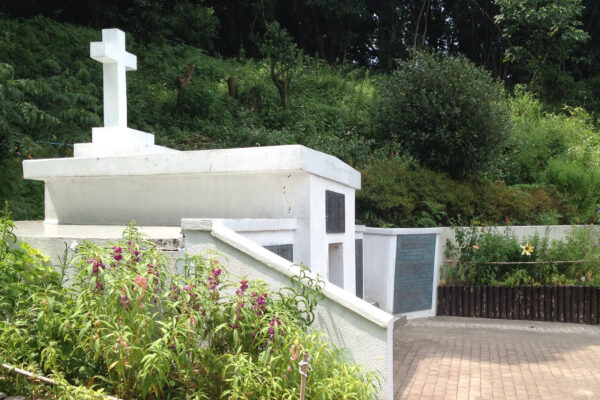
During the Pacific War (Great East Asia War), many prisoners of war were forced to labor in the coal mines of Mizumaki, Onga District (at the Orio POW Branch Camp). Mizumaki held a large number of Dutch prisoners, 53 of whom lost their lives there. Immediately following Japan’s defeat and just before the GHQ war crimes investigation, the Nittan Takamatsu Coal Mine hurriedly erected a cross as a memorial.
■ The Bond Between a Dutch Survivor and the Local Community
Dolf Winkler, a Dutch survivor and former prisoner at the camp, suffered from severe nightmares for 40 years after the war—what we now recognize as PTSD. Following the advice of a mental health counselor to face the source of his suffering, he decided to visit Mizumaki in 1985. Guided by author Eidai Hayashi, Mr. Winkler was led to the neglected and dilapidated cross. When he initially approached the town office for help, he was turned away because the cross was a religious symbol.
Eventually, he sought help from Shoji Kurokawa, who then consulted his older brother, Hiroshi. Hiroshi said, “It’s wrong for no one to take care of it since it’s here in Mizumaki. Let’s do it ourselves, as brothers.” The Kurokawa brothers took over the management of the memorial. When the weathered cross required repair, a local construction company owner stepped forward, saying, “My own brother died in the war; let me do this as a memorial service.” The restoration was completed, and the names of the 53 men who died in Mizumaki, as well as the 871 Dutch prisoners who perished in camps across Japan, are now engraved on the monument.
■ From Resentment to Exchange
Since 1987, a flower-laying ceremony has been held annually. Mr. Winkler visited Mizumaki many times, and many others followed from the Netherlands. Visitors included former POWs and bereaved families with strong anti-Japanese sentiments, individuals born to Japanese fathers and Dutch mothers during the war, and those who were forced into internment camps in Indonesia. Gradually, the town office also began to actively cooperate in the memorial services and international exchanges.
When Mr. Winkler first arrived in Japan, he never showed a smile. However, through his interactions with the people of Mizumaki, he slowly began to open up. He even started engaging with the local children. In his will, he requested that his ashes be scattered next to the Memorial Cross in Mizumaki. In 2009, both Dolf Winkler and Hiroshi Kurokawa, who had protected the cross together, passed away.
The friendship cultivated by Mr. Winkler and Hiroshi Kurokawa continues to serve as a bridge, healing the hearts of those in the Netherlands who still harbor bitterness from the war. Today, the bond lives on through annual homestay programs for junior high school students and cultural exchange events at local elementary schools.
■ Personal Reflections (2012)
In 2011, I learned about the Memorial Cross in Mizumaki, and in 2012, I visited the current representative, Hidetoshi Kurokawa, to participate in the flower-laying ceremony and exchange events. I served as a volunteer interpreter for the exchange program at an elementary school and was struck by the incredible energy of the children. Second graders greeted me in English and peppered me with endless questions during lunch.
I wondered how much these children truly knew about the dark history of the war and the POW issues that many adults try to avoid. Yet, their earnest hospitality seemed to breathe new life into the hearts of the Dutch visitors who had resented Japan for so long. Those once called “war victims” left Mizumaki with smiles on their faces.
I also saw a video online of Dutch junior high school students who had visited Mizumaki on a homestay. Witnessing the smiles of these children, I was amazed by what the Kurokawa brothers and the people of Mizumaki had nurtured over the years. I heard that Mizumaki has one of the highest participation rates in the Japan Overseas Cooperation Volunteers (JOCV).
Though I previously had no connection to the Netherlands, the activities of Mr. Winkler and Mr. Kurokawa—who transformed hatred and suffering into children’s smiles—allowed me to experience a new kind of international exchange. The friendship they grew has passed the torch to a new generation. The history and the lives of the Dutch prisoners will surely continue to live in a corner of the hearts of the children raised in Mizumaki as they head toward the future.
