The Great Yahata Air Raid
August 8, 1945
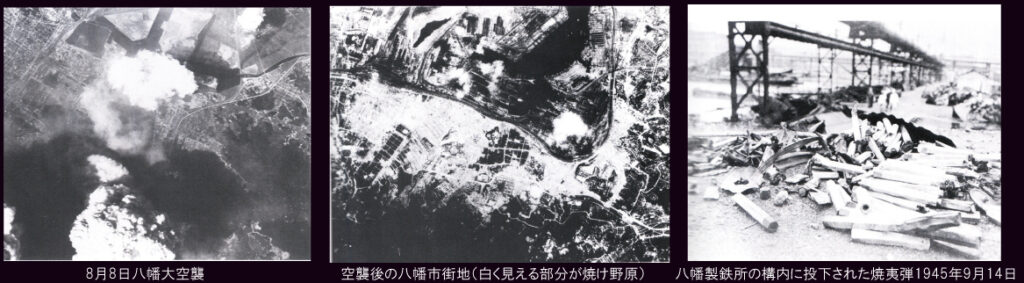
The target was a residential area where many employees of the Yawata Steel Works and their families lived. The areas currently known as Edamitsu, Chuo, Ogura, and Maeda in Yahatahigashi Ward were reduced to ashes. According to the Yawata City History (Sequel) and Kitakyushu City History, there were approximately 2,500 casualties, 52,562 people affected, and approximately 14,000 homes damaged or destroyed. According to the Japanese Urban War Damage Map (edited by the First Ministry of Demobilization), the death toll was 1,785. (Source: Nishinippon Shimbun Word Box)
[Photo Captions]
- Left: The Yahata Air Raid on August 8.
- Center: Yahata city area following the air raid (white areas indicate scorched earth).
- Right: An incendiary bomb dropped on the premises of the Yahata Steel Works (September 14, 1945).
Target Information Sheet
Excerpt from the U.S. military document: “Air Raids on Kitakyushu” (by Yoshishige Okuzumi and Yoichi Kudo)
Note: This text has been re-translated from Japanese sources as the original English document was unavailable at the time of publication.
DO NOT BRING ON BOARD DURING SORTIES.
Target: Yahata City Industrial Area Target Area: 90.34-Shimonoseki
Summary: The Yahata region is one of Japan’s four major urban industrial zones. Stretching south and west of the Shimonoseki Strait, it forms a narrow strip along the coast of Kitakyushu. This zone is a complex of five industrial cities and is home to one of the largest steelworks in Japan; a critical chemical plant associated with the coal carbonization facility of the Copper Refinery; massive thermal power plants; one of Japan’s most significant arsenals; and extensive railroad and shipping facilities.
Importance: The Yahata area has long been regarded as one of the most vital industrial centers on the Japanese mainland, often referred to as “Japan’s Pittsburgh” or “Japan’s Ruhr.” It is the heart of Japanese steel production, supplying vast quantities of pig iron, steel ingots, and rolled steel products to the surrounding regions. The large-scale development of heavy and chemical industries was essential to the Japanese military industry, as the byproducts from coke and coal processing plants also sustained national agricultural production.
Strategically located near the Shimonoseki Strait—the largest shipping hub in the Far East—the Yahata region possesses highly developed port and railway facilities. The Kanmon Tunnel, running beneath the strait, connects Honshu with northern Kyushu. Proximity to the Chikuho coalfield allows for the transport of 20 million tons of coal annually, utilizing the dense Kitakyushu railway network. Furthermore, the region generates its own electricity through thermal power plants, contributing significantly to the Kitakyushu power grid.
The total population of this region is approximately 650,000. Destroying the residential areas attached to this vast industrial complex with incendiary bombs would undoubtedly cause widespread absenteeism and social disorder. A substantial loss in steel production would cripple numerous associated factories across other cities and the rest of the Empire. Eliminating key thermal power plants would effectively halt all production in the region. Blocking Kitakyushu’s transportation lines would sever the flow of finished products, semi-finished goods, and by-products. Damage to major railway repair shops would severely strain the already overburdened land transport network, potentially impeding troop movements and supplies should operations commence in Kyushu. Additionally, damage to the strategic arsenal at Kokura would cut off Kyushu’s most accessible source of arms and ammunition. Destroying or damaging port facilities and associated shipyards would thwart Japanese efforts to increase maritime shipping as a relief for land transportation. Much of the equipment for coal and cargo handling is highly susceptible to damage and would be difficult to replace.
[List of Numbered Objectives within Urban Area Objective 3630] (Note: Preserving the original names and designations as recorded in the documents)
- 168 - Kokura Arsenal
- 184 - Kokura Railway Factory
- 2173 - Higashi Kokura Railway Yard
- 1127 - Kokura Thermal Power Station No. 1
- 188 - Kokura Thermal Power Plant No. 2
- 165 - Kokura Steel Works
- 1856 - Kyushu Special Steel Company (Kokura)
- 28 - Nippon Steel (Yawata)
- 28A - Nippon Steel Thermal Power Plant
- 28B - Nippon Steel Thermal Power Plant
- 569 - Kyushu Chemical Industry (Yawata)
- 567 - Asahi Glass Subsidiary (Yawata)
- 1851 - Nippon Gosei Kogyo (Yawata)
- 2169 - Yawata Railway Operation Depot
- 1108 - Japan Aluminum Company (Kurosaki)
- 1113 - Nippon Gosei Kogyo (Kurosaki)
- 1126 - Yaskawa Electric Company (Kurosaki)
- 1866 - Kokura Port Facilities
- 1860 - Toyo Special Casting Company (Kokura)
- 177 - Osaka Soda Company
- 1857 - OKUMA Iron Factory
- 1859 - Tokyo Steel Cable Manufacturing Company (Kokura)
- 2170 - Tobata Railway Yard
- 33 - Tobata Port Facilities
- 29 - Nippon Steel Tobata Branch Factory
- 1594 - Tobata Thermal Power Plant
- 1853 - Tokyo Can Company (Tobata)
- 1852 - Hitachi Machinery Works (Tobata)
- 2171 - Wakamatsu Railway Yard
- 561 - Wakamatsu Railway Factory
- 1672 - Wakamatsu Shipyard
- 558 - Tochigi Shipyard
- 32 - Wakamatsu Port
- 1123 - Japan Liquid Fuel Company (Wakamatsu)
- 1864 - Tokai Steel Manufacturing Company (Wakamatsu)
- 555 - Tokai Steel Manufacturing Company (Wakamatsu)
- 1861 - Hitachi Machinery Works (Wakamatsu)
XXI Bomber Command, A-2 Target Section June 20, 1945