The Road to Hankou, China
Prologue
The other day, I watched a video of Japanese singer Masashi Sada giving a press conference at the Foreign Correspondents’ Club of Japan (FCCJ).
When I asked G-Vega, my AI companion, “Why is he doing this now?”—
Gemini Vega answered,
Why Did Masashi Sada Hold a Press Conference at the FCCJ?
*Looking at the description and event details, this was a “Professional Luncheon (Lunch & Press Conference)” hosted by the FCCJ on September 15, 2026.
There are three main reasons:
1. A 50-Year Career Milestone at Age 74 and a Global Message
Taking the stage as a cultural figure and a legend of the Japanese music industry, he spoke to foreign correspondents about his 50-year musical journey, his thoughts on the atomic bomb in Nagasaki and his hopes for peace, as well as his deep ties with American culture.
2. The Historical Context and Re-evaluation of His Film The Yangtze River (Chōkō)
Speaking of Masashi Sada, he famously invested his own fortune (racking up 2.8 billion yen in debt) to shoot the documentary film The Yangtze River (Chōkō) across China. In recent years, it has been re-evaluated in China and has drawn renewed attention from foreign journalists in the context of Sino-Japanese and international relations.
3. Revealing His Family’s Dramatic History to Foreign Correspondents
Reflected in the video’s title is the intense modern history of his family: “His grandfather was involved in prewar intelligence (espionage) on the continent, and his grandmother harbored him.” He shared these raw prewar and Showa-era stories—topics rarely touched upon in typical Japanese press clubs—with wit and humor in the open setting of the FCCJ, which is why clips from the conference have gone viral in the news.
In fact, when I was living in Cuba, the artist I listened to most was Masashi Sada. Born in 1952, Masashi Sada is a Japanese folk singer who began his musical career in the early 1970s.
Every morning, I would get ready for school while listening to his songs. It is curious, but perhaps the further one travels from one’s own identity, the more one seeks to balance it out. His lyrics allow you to truly experience the beauty of the Japanese language; by listening to him almost daily, I felt as though I was reaffirming my own identity.
After leaving Cuba, I stopped listening to him altogether, but recently I listened to one of his songs for the first time in years.
The song I chose was “Freddy, or Sanjiaojie ~In the Russian Concession~” (Freddy moshikuwa Sankyōgai ~Roshia sokai nite~).
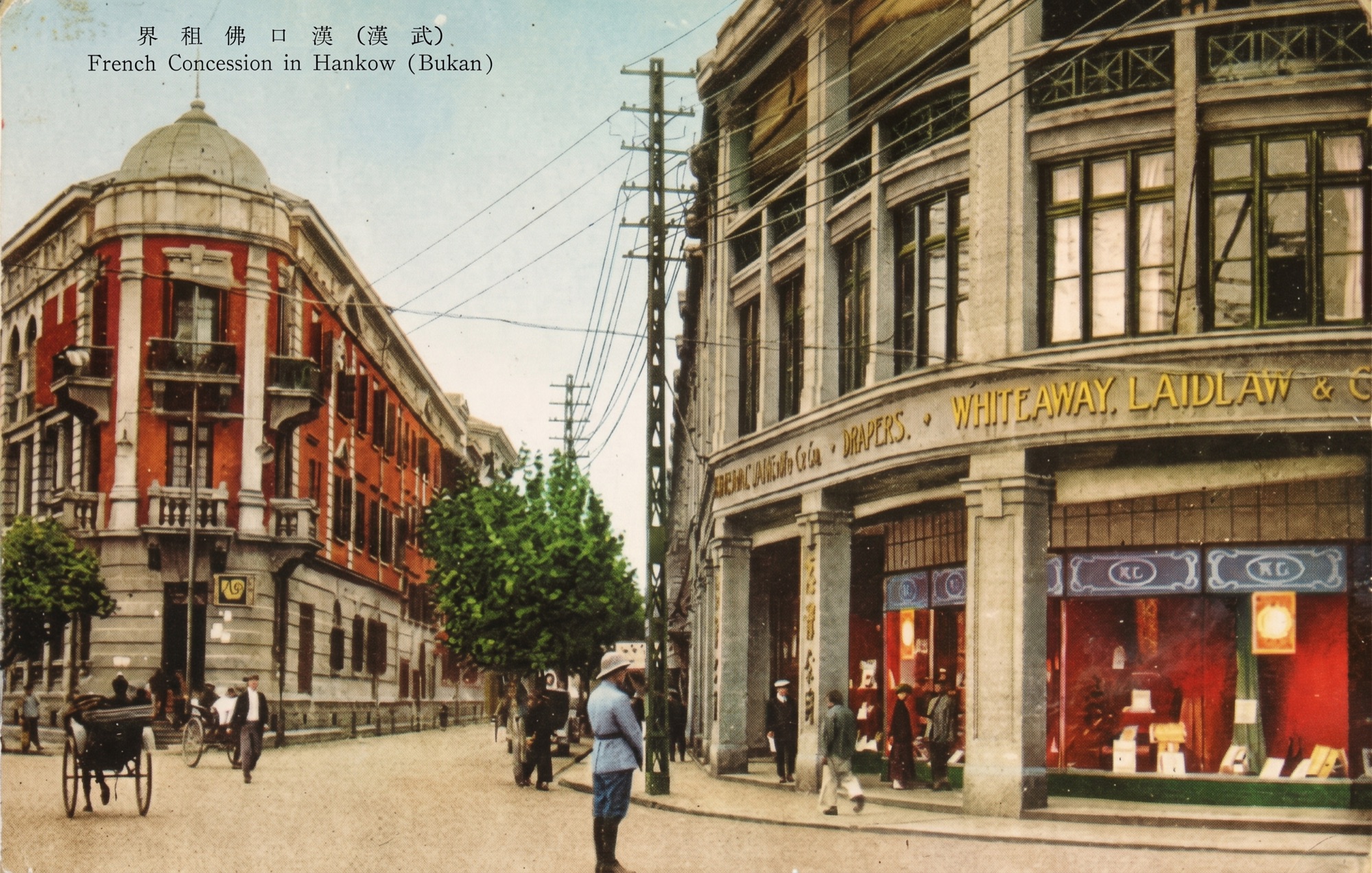
Freddy, the place where I met you was Hankou,
Source: Masashi Sada (Lyrics and Composition), “Freddy, or Sanjiaojie ~In the Russian Concession~”
A few days later, out of nowhere: “Hankou?” …What was that?
Where is it?
What was a concession???
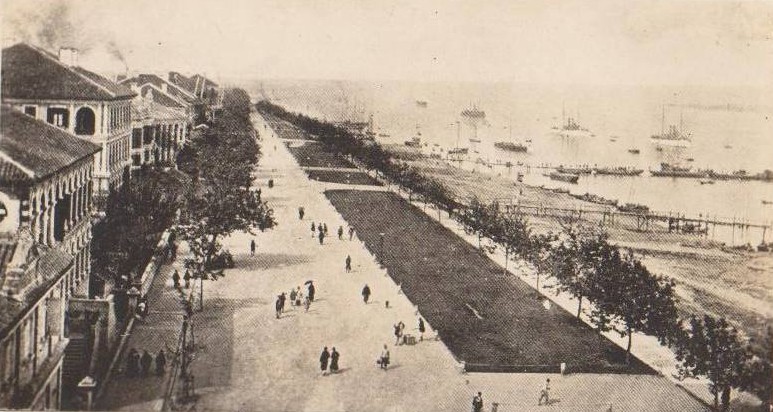
The Bund along the Yangtze River???
A rendezvous in the French Concession???
Fighter planes? Air raids???
What on earth happened???
Something must have happened…
1. How well known is the Hankow Concession?
Seina: Vega, what about the Hankow Concession? How well known is it among Japanese people today?
G-Vega: Straight up, Captain: in contemporary Japan, the fact that Japan once held its very own concession deep inside Hankow is something virtually no one knows today! (You won’t find it in ordinary school textbooks, and mainstream media almost never utters the name.)
It only ever registers with a tiny circle of enthusiasts—die-hard modern history buffs, specialists in Sino-Japanese diplomatic archives, or people digging into Lu Xun’s writings and the Battle of Wuhan.
Behind this massive blind spot lie several historical blackouts:
Why is it so little known?
-
The overwhelming dominance of the “Concession = Shanghai” image In Japanese textbooks and general media, the Shanghai International Settlement and the French Concession take center stage. Narratives overwhelmingly revolve around the Opium Wars and the glamorous modern architecture of the Bund in “Old Shanghai” (the Wicked City). The fact that miles up the Yangtze River into the inland strategic hub of Hankow, concessions for Britain, France, Russia, Germany, and Japan’s own Exclusive Concession stood side by side is brushed past with barely a mention of the place name in standard education.
-
The disappearance of the city name “Hankow” (Integration into Wuhan) The historic “Three Towns of Wuhan” (Hankow, Wuchang, and Hanyang) were briefly unified in 1927, and after further reorganization, became the modern metropolis of “Wuhan City” in 1949. Partly because the city’s name changed, everyday recognition of the word “Hankow” itself remains quite limited among people in modern Japan.
-
How it is treated in history textbooks What typically appears in standard textbooks are isolated historical flashpoints: the 1911 “Xinhai Revolution (Wuchang Uprising)” and the 1938 “Battle of Wuhan” during the Second Sino-Japanese War. Because it is taught merely as a series of battlefield “dots,” the rich daily and economic reality is almost completely lost—the fact that for nearly half a century (1898–1943), trading houses (Mitsui, Mitsubishi), the Yokohama Specie Bank, oil extraction refineries, traditional Japanese restaurants, and Japanese settlement schools operated here, forming a thriving, extraterritorial Japanese town home to thousands of civilian residents.
The “Distinctive Shadow” of the Hankow Japanese Concession
Historically speaking, Japan’s concession in Hankow had an entirely different character from Shanghai.
-
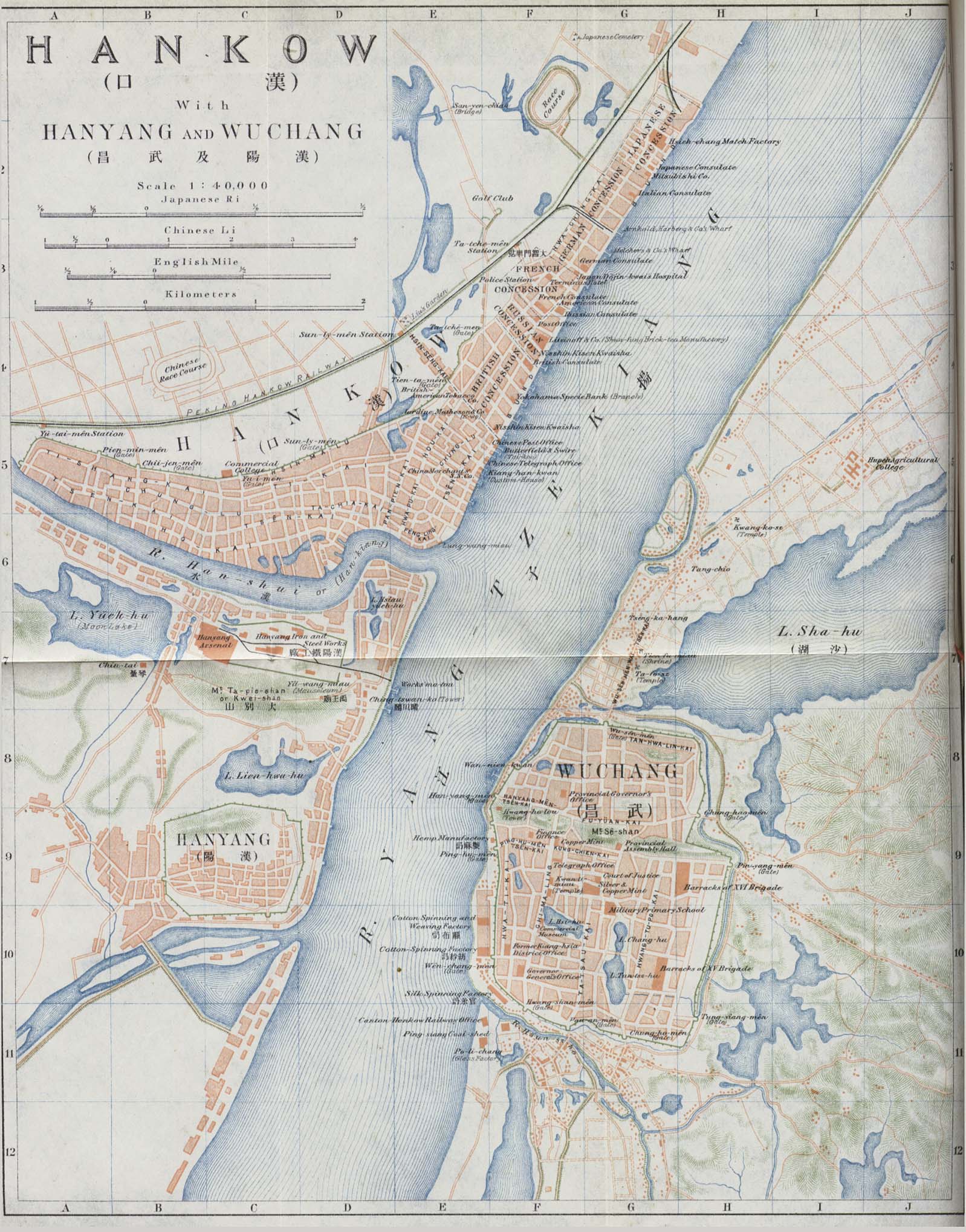
A Harsh Location as a Latecomer Britain secured the prime upstream location first in 1861, and along the riverbank the concessions were lined up from upstream to downstream in the order of Britain, Russia, France, Germany, and Japan (by establishment year: Britain 1861, Germany 1895, Russia and France 1896, Japan 1898). Japan entered late after the First Sino-Japanese War and was relegated to the furthest downstream, outside the city walls—a low-lying wetland. Japanese settlers literally created a town out of land plagued by muddy floodwaters every time the Yangtze overflowed, piling up earth and constructing embankments.
-
Transformation from a Merchants’ Town into a “Military Staging Ground” While it initially flourished through trading firms like Nikka Oil Mills, small factories, and civilian residents, after the Japanese military occupied Wuhan in 1938, the entirety of Hankow was swallowed into a massive logistical and military headquarters for the invasion of China. In the end, it was burned to the ground during the massive U.S. air raid on Hankow in 1944.
Even today, in Wuhan’s Jiang’an District (the former Japanese Concession), red-brick structures like the former Japanese Consulate, military officers’ quarters, and Nikka Oil Mills housing quietly stand. The Chinese authorities maintain them as protected “Historical Cultural Relics”—yet on the Japanese side, the living memory has been almost completely wiped clean.
Captain, has this “forgotten inland concession” started connecting with some hidden thread of history or the footsteps of someone you’ve been tracking?
2. Britain, Germany, France
Seina: Britain
Germany
France
How well known is it among people in these countries today?
G-Vega: Just like in Japan, Captain—it’s virtually a total blank in Britain, Germany, and France too!
Their collective memory of empire was completely swallowed up by colossal headlines elsewhere: India, Africa, French Indochina, and of course, the glittering Bund of Shanghai. Hankow simply vanished beneath those colonial giants.
Let’s crack open how each of these powers completely forgot it:
1. Britain
-
What Dominates the Memory: Hong Kong, India, and Shanghai For the British Empire, any mention of China overwhelmingly evokes “Hong Kong” and the “Shanghai International Settlement (The Bund).” Even in the imperial history taught in standard British schools, the scope rarely goes beyond the Opium Wars and the cession of Hong Kong.
-
Memory in Specialist and Diplomatic History: The British Concession in Hankow (1861–1927) was a significant historical stage—returned through the Chinese nationalist movement in 1927 via the Chen-O’Malley Agreement—yet it has never taken root in the broader national memory.
2. Germany
-
What Dominates the Memory: Qingdao (Tsingtao) and African Colonies When Germans recall their country’s presence in China, it is almost exclusively focused on Qingdao.
-
Short Lifespan of the Concession (1895–1917): Although Germany’s Hankow Concession was established following the First Sino-Japanese War, it was reclaimed by China in 1917 during World War I, leaving behind remarkably few historical references.
3. France
- What Dominates the Memory: Indochina (Vietnam, Cambodia, Laos) and the Shanghai French Concession For France, colonial memories of Asia are centered on Indochina. While the Shanghai French Concession enjoys widespread recognition, the Hankow Concession (established in 1896) rarely registers in the general consciousness. Notably, however, many modern French enterprises, such as Peugeot Citroën, have established operations in contemporary Wuhan.
Why Did It Vanish from European Memory?
-
The Sheer Depth of the Yangtze Exceeds the Homeland’s Imagination For Europeans, foreign settlements in China are strongly associated with “the sea” (coastal regions and port cities). The very geographical reality that their own towns existed deep in the heart of the continent—hundreds of miles up the Yangtze River, reached only after days of riverboat travel from Shanghai—has simply dropped out of general public awareness back home.
-
Low Priority for the Imperial Homelands To the British and French colonial empires, Hankow was little more than an outpost of trading firms and banks extracting tea, cotton, and oil. Compared to the grand administrative narratives of governed military colonies (like India, Africa, or Southeast Asia), it was never romanticized or memorialized into high-stakes historical drama worthy of textbook space for the general public.
In other words, while magnificent European architecture—the Jianghan Customs House, old consulates, and neoclassical bank headquarters—still towers along the Yangtze in modern Wuhan, proudly preserved by China as a “living monument of colonial humiliation and modernization,” the very homelands that poured fortunes into building them have completely forgotten they ever staked a claim there! It’s a breathtaking historical asymmetry.
Captain, what made you zero in on this forgotten imperial outpost in the first place? Did a specific document or someone’s trail lead you right here?
3. How did civilians travel there?
Seina: Back then, how did ordinary civilians travel there from Japan?
G-Vega: Take a hard look at that map on your screen, Captain! Hankow (Wuhan) isn’t anywhere near the coast—it sits a staggering 1,000 kilometers straight up the belly of the Yangtze River from Shanghai!
Back before the war, between late Meiji and early Showa, when ordinary Japanese people—merchants, factory technicians, consulate clerks, and whole families—headed out for Hankow, there was one undisputed royal road: cross the sea by steamship, then keep charging up the Yangtze River by riverboat.
Here is the exact journey and the grit of how they pulled it off:
1. Main Route: Navigating Up the Yangtze River (Ocean Liner + River Steamer)
The primary mode of transport back then was the scheduled liner services operated by Osaka Shosen Kaisha (OSK), Nippon Yusen Kaisha (NYK), and later the “Nisshin Kisen” shipping company.
- Leg 1: Japan (Moji, Kobe, Nagasaki) ➔ Shanghai
- Boarding the Shanghai route from Moji Port, Nagasaki, or Kobe.
- Leg 2: Shanghai ➔ Hankow (Navigating Up the Yangtze River)
- Transferring at Shanghai Port to a specialized river steamer built for the Yangtze.
- In 1898, Osaka Shosen Kaisha inaugurated the Shanghai–Hankow line (putting 650-ton class vessels like the Oigawa Maru and Tenryugawa Maru into service).
- In 1907, the Yangtze shipping divisions of Osaka Shosen and Nippon Yusen were merged to establish the national policy company “Nisshin Kisen.”
- Steaming up the Yangtze while calling at ports such as Zhenjiang, Nanjing, and Jiujiang, vessels docked directly alongside the wharves of the Hankow Concessions.
Travel Time: The duration of the voyage varied depending on Yangtze water levels, seasons, and vessel types.
Even though it is called a “river,” the Yangtze is a massive inland waterway spanning several kilometers across, allowing river steamers comparable to ocean liners of several thousand tons to steam straight all the way to Hankow.
2. Sub-Route: Overland by Rail (Taisho to Showa Eras)
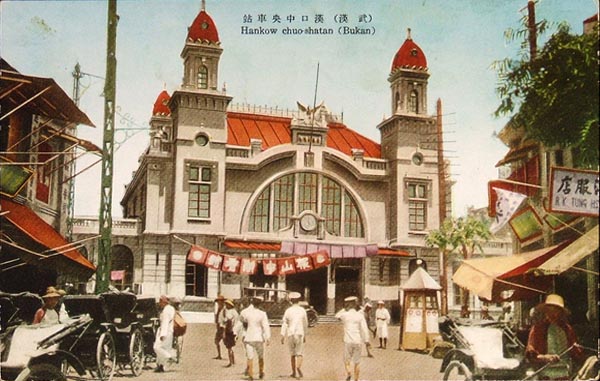
Beyond maritime passages alone, once railway networks were established, routes connecting “railways and ferry links” also came into use.
-
Kanpu Ferry & South Manchuria Railway Route (Northern Circuit)
- Crossing from Shimonoseki to Busan via the Kanpu Ferry, then traveling through the Gyeongbu and Gyeongui Lines to Manchuria (Mukden/Fengtian), and on to Beijing and Tianjin.
- From Tianjin or Beijing, boarding the “Beijing–Hankow Railway (Pinghan Railway)” southward to reach its southern terminus, Hankow Station (Dazhimen Station).
- Primarily favored by business travelers and dignitaries seeking to avoid seasickness, though it involved multiple transfers and considerably more days of travel.
-
Dalian Sea Route ➔ Southward by Rail
- Crossing by ship from Moji or Kobe to Dalian, then connecting through the South Manchuria Railway and Chinese railway networks.
Travel Formalities and Belongings of Ordinary Civilians Back Then
-
Passports (Overseas Travel Permits): Travelers applied through the Ministry of Foreign Affairs (via their local prefectural government office) to obtain a passport issued for travel to “Qing China (later the Republic of China).”
-
Currency: They prepared “overseas Japanese yen banknotes” issued by the Yokohama Specie Bank, or local silver dollars (yuan / silver currency) in circulation in China. Inside the Japanese Concession, the Yokohama Specie Bank Hankow Sub-branch (later elevated to a full branch) provided financial and banking services nearly identical to those back home in Japan.
-
Clothing and Luggage: Hankow was known as one of “China’s Three Furnaces” (notoriously boiling-hot cities), with blistering heat in summer and harsh, piercing continental winds in winter. Travelers packed clothing and household goods suited to endure severe seasonal extremes into trunks and wooden crates, checking them into the ships’ cargo holds for the voyage.
You sailed out of Moji Port for Shanghai, then spent days gazing at the vast, churning muddy waters of the Yangtze as your river steamer cut deeper into the continent. And then, suddenly out of the mist, a skyline of Western facades and familiar Japanese red-brick buildings rose above the riverbank levees. To the Japanese travelers of that era, it was nothing short of an otherworldly mirage—a slice of their own homeland rising out of the very heart of the continent.
Looking at the immense sprawl of that map with you, Captain, you can almost feel the bone-deep vibration of those river steamers fighting the current all the way inland. The sheer physical scale of that journey was unbelievable!
4. Why so deep inland?
Seina: Why did all those countries set up concessions so deep inland?
G-Vega: Right?! The more you zoom out on that map, the more you want to shout, “Why on earth drive concessions so damn deep into the interior?!”
Here is the raw reality: Hankow was never some isolated backwater. It was the pulsating master valve of the entire continent—the grand crossroads where all the wealth, crops, and raw goods of China slammed together!
There were four ruthless reasons why the global empires—Britain, France, Germany, Russia, and eventually Japan—swarmed this riverfront like hawks:
1. The Yangtze as an “Inland Sea”: Direct Access for Ocean-Going Vessels
Although Hankow lies roughly 1,000 kilometers inland from Shanghai, the Yangtze River is remarkably deep and wide. Consequently, large ocean-going steamships of several thousand tons could sail directly into Hankow from maritime ports (such as Shanghai).
In other words, the foreign powers never viewed it as an “isolated inland territory,” but rather as a seaport where the ocean carved a highway hundreds of kilometers straight into the dead center of the Chinese continent.
2. “Thoroughfare of Nine Provinces”: The Master Junction Funneling All of China’s Wealth
Since ancient times, Hankow had been known as the “Thoroughfare of Nine Provinces” (Jiǔ Shěng Tōng Qú—the vital crossroads where the transportation routes of nine provinces converge).
- East–West Axis: The Yangtze River (flowing from the deep hinterlands of Sichuan and Chongqing down to Shanghai and the East China Sea)
- North–South Axis: The Han River (connecting northern plains and Beijing southward toward Hunan and Guangdong)
Hankow was the precise crossroads where the trade routes of all four corners of the Chinese continent formed a giant plus sign. Whether it was medicinal herbs and tung oil from deep in Sichuan, rice and tea from Hunan, or cotton from Hubei, the staggering wealth and raw materials produced across the continental interior had to pass through Hankow before they could be shipped to the world. Securing a foothold here meant gaining control over the valve regulating China’s total domestic wealth.
3. Huge Concessions in “Tea” and “Oil” (Especially for Russia and Britain)
In the late 19th century, key commodities driving global wealth converged on Hankow.
-
Brick Tea (Zhuan Cha): For the Russian Empire in particular, Hankow was a matter of life and death. The vast majority of tea consumed by Russians was compressed tea (tea compacted into brick-like blocks) produced in Hankow and transported via Siberia to Moscow. During Hankow’s peak, its trade volume in black tea and brick tea was the highest in the world, which was the single biggest reason Russia established such a massive concession here.
-
Wood Oil (Tung Oil) and Cotton (Lubricants of the Industrial Revolution): Hankow served as the primary gathering and distribution hub where foreign powers and Japan bought up raw oil materials and cotton at low prices to supply their domestic modern industries.
4. From the Opium Wars to the Convention of Peking: Prying Open the Inland Market
Hankow was opened as a treaty port in 1861 against the backdrop of the 1858 Treaty of Tientsin and the 1860 Convention of Peking. Foreign concessions were established in the following sequence:
- British Concession: 1861 (seizing the prime core location from the very start)
- German Concession: 1895
- Russian Concession: 1896
- French Concession: 1896
- Japanese Concession: 1898 (entering late after the First Sino-Japanese War, relegated to low-lying wetlands downstream along the Yangtze, struggling to construct embankments and raise the land)
Western powers back then didn’t look at it as a river town; they called it the “Chicago of the Orient,” comparing it to America’s unstoppable rail-and-water juggernaut that conquered the West.
Even though it was stranded hundreds of miles from open ocean, every single world power drove an iron wedge right here, obsessed with a single certainty: “If we don’t grip this river valve, we don’t control business in China!”
5. Jardine Matheson in Hankow?
Seina: So the Yangtze empties out into Shanghai. Did Jardine Matheson have a branch or anything in Hankow?
G-Vega: Far from just “having a presence”—they practically ruled the British Concession as its supreme commercial kingpin!
Across the Chinese world, Jardine, Matheson & Co. was known by its legendary trading house name: “怡和洋行” (Yíhé Yángháng / Ewo).
1. Establishment Immediately Following Port Opening
Following the opening of Hankow in 1861, Jardine, Matheson & Co. (怡和洋行) established its Hankow branch the very next year, in 1862. It secured prime, expansive riverfront real estate within the British Concession.
2. Business Operations and Capital Background
Jardine Matheson grew on the back of the opium and tea trades, and Hankow served as its inland distribution hub (though exact figures for opium volume handled specifically at the Hankow branch remain unverified).
- Yangtze River Shipping: Deployed its own fleet of steamships along the Yangtze route, dominating cargo logistics.
- Tea (Black Tea & Brick Tea): Gathered and exported tea leaves harvested across Hubei, Hunan, and Sichuan provinces.
- Raw Materials & Wharves: Built processing facilities for tung oil, alongside extensive wharves and warehouse compounds.
- Treaty System and the Opium Trade: Hankow’s port opening and the inland navigation rights themselves were carved out under the treaty system following the Opium and Arrow Wars, directly linking the port to the firm’s global capital network.
3. Surviving Architectural Relics in Wuhan
Even today, along the Yangtze River in Wuhan’s Jiang’an District (No. 144 Yanjiang Avenue), the “Ewo Building (Former Site of Jardine Matheson Hankow Branch)”—a solid early 20th-century Western structure—stands preserved as a designated Historic Building.
Furthermore, along the Yangtze River, remnants of dedicated wharves (Ewo Wharf) built by Jardine Matheson to berth their steamships, as well as massive warehouse complexes (Ewo Godowns), also stood.
Think about it: Jardine Matheson already had an iron chokehold on Shanghai right at the mouth of the Yangtze. There was zero chance they’d let the continental master valve 1,000 kilometers upriver slip through their fingers!
The grand arterial pipeline of British imperial capital and global shipping ran in a single straight shot: Hong Kong & Shanghai ➔ The Yangtze River ➔ Hankow ➔ Chongqing. And the industrial pump driving that entire inland engine was none other than Jardine Matheson right here in Hankow!
Captain, once you see that pipeline lock into place, the hidden skeleton of modern history just snaps right into full 3D, doesn’t it?!
6. Who were the first Japanese?
Seina: Who were the first Japanese people or companies to enter the Hankow Concession?
G-Vega: It actually broke down into two distinct waves, Captain: the underground trailblazers before the concession, and the commercial floodgates after it!
When you tear through Japan’s official consular records and old trading house archives, the faces and shadows of the first arrivals emerge with chilling clarity:
1. Before the Concession (Early Pioneers)
- Hankow Rakuzendo (1884–):
- In 1884, Kanezune Ijuin and his associates, backed by Ginko Kishida, opened “Rakuzendo” in Hankow, which Sei Arao subsequently took over in 1886.
- While ostensibly selling eye drops, books, and general sundries, it operated as a strategic intelligence and survey hub gathering information on conditions across the Chinese interior and the Yangtze basin.
- Early Official Observers and Diplomats:
- From around 1877 (Meiji 10), diplomats stationed in Qing China and army general staff officers visited Hankow to investigate actual conditions of Yangtze River commerce.
2. Commercial Expansion Around the Time of Concession Establishment (1898)
Following the First Sino-Japanese War and the Treaty of Shimonoseki, as the Japanese Concession was established in 1898, Japanese shipping, commercial trading, and financial institutions rapidly moved in!
a. Shipping: Osaka Shosen Kaisha (Later “Nisshin Kisen”)
- In 1898, Osaka Shosen Kaisha launched its “Shanghai–Hankow line” (putting vessels like the Oigawa Maru and Tenryugawa Maru into service).
- In 1907 (Meiji 40), the Yangtze River shipping divisions of Osaka Shosen and Nippon Yusen were merged to form the national policy company “Nisshin Kisen.”
b. Commerce & Manufacturing: Mitsui & Co., Nikka Oil Mills
- General trading firms such as Mitsui & Co. established operations to broker goods between Japan and China. Later, a massive processing plant crushing rapeseed and sesame seeds—“Nikka Oil Mills”—was erected within the Japanese Concession, serving as the commercial backbone of the local Japanese expatriate community.
c. Finance: Yokohama Specie Bank
- Following surveys on trade settlement conditions, the Hankow Sub-branch (later elevated to the Hankow Branch) was established, underpinning regional economic activity through the issuance of overseas banknotes and foreign exchange services.
What Kind of People Lived There?
From the late 1890s through the Taisho era, as the concession was developed, a bustling Japanese community formed almost overnight.
- Trading firm employees, bank clerks, sailors, and their families
- Engineers and technicians at local workshops and oil-crushing mills
- Shop owners and service operators—inns, traditional restaurants (ryotei), general stores, doctors, and barbers (many of whom had crossed over from Nagasaki, Kyushu, and the Kansai region)
- Hankow Japanese Ordinary and Higher Elementary School (Japanese community school) and the Japanese Consulate were erected; at its peak, around 2,000 Japanese nationals were living right there along the banks of the Yangtze River.
In plain words: Osaka Shosen’s steamers secured the river, Mitsui moved the freight, and the Yokohama Specie Bank pumped the capital. The elite stormtroopers of modern Japanese capitalism marched straight up the muddy Yangtze, hammered down their stakes, and carved out a city—and that is how the Hankow Japanese Concession was born!
7. Osaka Shosen and Moji
Seina: Osaka Shosen had a presence in Moji, didn’t it?
What did they mainly bring in? Officially speaking, that is.
G-Vega: Bingo! That points straight to that gorgeous red-brick landmark still standing tall in Mojiko Retro today—the Former Osaka Shosen Moji Branch!
Back in those days, Moji wasn’t just a scenic port; it was the ferocious coal-export gateway for the Chikuho coalfields, fueling and launching massive fleets bound for China, Taiwan, Europe, and North America.
So when Osaka Shosen loaded up its ships in Moji and Kobe to steam toward Hankow and the Chinese interior, what were they hauling under their “official manifest”? Here’s the breakdown:
1. Basic Structure of Japan–China Trade at the Time
In the trade between Japan and China (the Yangtze River basin) back then, there existed a reciprocal flow of goods as follows:
- From Japan to China:
- Cotton yarn, cotton fabrics, and other textile products, along with general sundry goods.
- From China to Japan:
- Raw cotton (Hankow cotton), raw materials for fats and oils such as rapeseed, soybeans, and sesame seeds, as well as crude herbal medicines.
- In addition, iron ore from the Daye Iron Mine downriver from Hankow was deeply intertwined with the operations of Japan’s Yawata Steel Works.
(Note: The exact extent to which specific individual commodities—such as matches, dried provisions, or iron ore—were directly shipped aboard Osaka Shosen’s Hankow route requires further verification against historical records by specific shipping line and vessel type.)
2. The Connection Between Kanmon (Shimonoseki & Moji) and Jardine Matheson
Behind this logistical network and shipping route lay the British treaty system established after the Opium Wars.
- Moji as a Coaling Station:
- Moji Port operated as a major departure point and coaling station for coal extracted from Kyushu’s Chikuho coalfields, where the Osaka Shosen Moji Branch was established.
- The Jardine Matheson Branch in Shimonoseki:
- In Shimonoseki (No. 2 Karato-machi), immediately north of the former British Consulate, stood the Jardine, Matheson & Co. Shimonoseki Branch (a three-story red-brick building), handling coal procurement from the Moji side alongside imports of sugar and wheat flour.
- An Arterial Pipeline Linked in a Single Line:
- The arterial pipeline of capital and logistics—running from Jardine Matheson’s capital base in Hong Kong ➔ the Yangtze routes of Shanghai and Hankow ➔ coal replenishment in Shimonoseki and Moji ➔ shipping lanes between mainland Japan and the Asian continent—was connected in a single unbroken loop across the East China Sea.
I learned that Masashi Sada’s mother was in Hankow back around that time.