As long as I trust in music, it always brings me an abundance of joy.
Dedicate to Grady Tate, Bob Cranshaw and Leonard Gaskin.
My Story
Shoko Shiraishi a.k.a “Seina”
Before starting “project”
- Childhood – A Lonely Universe and the Magic of a Car Stereo
- Teenage Years – Prayer, Rock, and “Que Será, Será”
- Age 20 – The Miracle on 45th Street
- New York Years – The Little Nobody Loved by Legends
- Interlude: – Grady Tate, Mariko-san and me
After 1999 – Projects
Angels Swing Project
- 1999 — I Have a Dream…Seina -The Songs for Nursing Homes in the U.S.
- 2008 — I’ll Be Seeing You, Mr. Leonard Gaskin
- 2011 — Thanks for the Memory -with Bob Cranshaw
- 2013 — “We Remember You” -Wartime and Postwar Kitakyushu
- Tribute — “For The Boys” -Tribute to Ms. Monica Lewis
- Ongoing — The Mystery Entertainment
- Ongoing — The Brooklyn Bop Brothers
Cuba Project
- 2015 — Cupie Danny -with Danny Rojo
- 2017 — Por La Chocolate -Recording in Cuba
- 2023 — Tribute to Juan-Carlos Formell -Los Van Van
- 2023 — Murakami Mambo -Study of Ryu Murakami and El TOSCO
- Ongoing — JAPONÉSON -Study of Post-Revolution Music by Cubans
Cabin1701 Project
- Ongoing — Cabin1701 -A project exploring culture, memory, and creation with multiple AI collaborators.
- Our books → https://cabin1701.com/books/
1. A Lonely Universe and the Magic of a Car Stereo
I loved this world. But it was painful.
In elementary school, I was bullied. My body was covered in bruises. My father had been a piano teacher, but when I was born — his second child — he decided music alone couldn’t support a family, so he opened a health food store. Both my parents were busy. So I was lonely.
Or maybe it was something else. Looking back now, I think my sensibilities were just a little different, and my parents didn’t quite know what to do with me.
My father loved music. So I decided that if I loved music too, he would love me back. I went searching for the songs that made him smile. Without realizing it, music became the thing that expanded my inner world like a universe — lifting me out of a lonely reality and carrying me somewhere else. I savored stories there, fantasized, and layered them many times over. Song lyrics glittered in that place.
The bullying started around fifth grade. My family had moved, and to spare me the disruption of changing schools, my parents registered our address at the store — which meant I was attending school from outside the official district. Every morning, my father — who had a passion for cars — would drive me to school in whatever stylish new car he had at the time.
Years later, I understood: that drive to school stirred something jealous in my homeroom teacher. “Must be nice for you,” he said in front of the whole class. The boys began chanting “Out of district! Out of district!” — surrounding me, kicking me. When the teacher walked in, it stopped. The wooden floor. The dust. Their feet. He was a mean, humanly unpleasant teacher. That same teacher, in music class, would call on me with a smile.
That same teacher, in music class, would call on me with a smile. “Shiraishi. Sing.”
In the car each morning, my father played Shirley Bassey — “Diamonds Are Forever,” “Goldfinger” — and Quincy Jones’ “Ai no Corrida,” loud, on a very good stereo. When “Ai no Corrida” came on, I forgot for a moment the fear waiting at school. I even felt something like excitement. I didn’t want to go. But I loved that time in that car.
My father tried many times to teach me piano. I never learned. I couldn’t read sheet music either. But I had something else — a sensor for feeling, brighter than anyone around me.
That’s probably why I ended up meeting the people I met. Why the real musicians found me.
The universe always knows. It arranges the meetings.
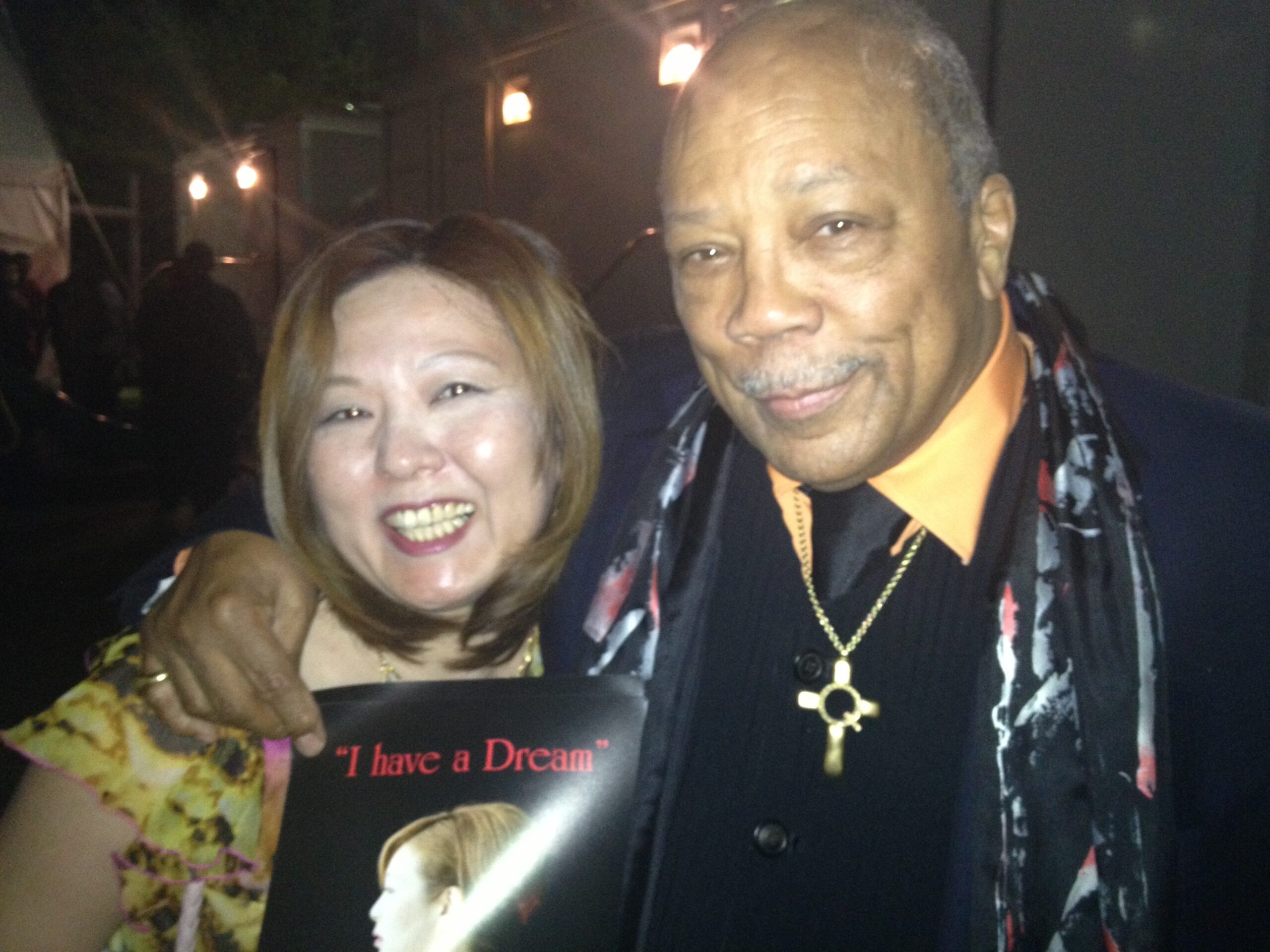
- Quincy Jones. The universe always collects its foreshadowing at exactly the right moment.
Return to Table of Contents
2. Prayer, Rock, and “Que Será, Será”
I escaped the bullying by using it as an excuse — I applied to a private middle school in Shimonoseki, in the neighboring prefecture of Yamaguchi. Baiko Jo Gakuin, a Christian school with deep historical roots.
In Japan, Christian schools are called “mission schools.” I didn’t fully understand what that word meant until I traveled through Paraguay in South America, years later. But that’s a story for another chapter.
The physical bruises stopped at this school. But I still didn’t fit. I sank. My grades stayed somewhere in the bottom ten. I couldn’t understand the point of studying. Reading was difficult, almost painful.
But in second year of middle school, one book reached me: the autobiography of Édith Piaf, “Ma Vie.” Her rough, unpolished writing went straight into my chest.
Around that time I saw “The Glenn Miller Story” at a revival screening. When the music of that era filled the theater, something in me recognized it — familiar, warm, like coming home. When “Little Brown Jug” played in the final scene, tears came by themselves. Not sadness. Something deeper. What I’d now call a soul responding.
Then my legs broke out in a terrible rash. It spread and worsened until I could barely walk. No doctor could find the cause. My mother said: “Go to your father.”
A few years before, my father had entered the world of Shugendo — a Japanese ascetic practice weaving together Buddhism, Shinto, and something older. Mountain retreats. Austere discipline. Spirit work. I had resisted it. But the rash wouldn’t heal. So I sat down in front of him.
And I burst into tears. “I want to go back to America,” I said — though I had never lived there. The conclusion arrived: perhaps I had been an American soldier who died in fire, in a past life. My father told me to buy a statue of Mary and pray to it every day. Within a few days, the rash was gone.
That was when my questioning of the spiritual began — and never stopped.
In middle school I had exactly one friend. She was always in the top five of our class. We went to live music venues together after school, on weeknights. One day, the school called our parents in. My father was summoned. “Your daughter has been going to live music venues, which are forbidden by school rules.”
My father answered: “Is music something bad? My daughter goes there to listen to music.”
That night, over his evening drink, he said happily: “I used to go to live venues all the time.”
I kept going to school because I was afraid of my father’s anger if I didn’t. But most mornings, I sat at the Mister Donut in front of the station and watched the train to Shimonoseki leave without me.
There was a young woman who worked there — Matsuzaki-san, around 21. She always noticed me. On the days it was obvious I couldn’t face it, she’d fill a bag with donuts: “Shoko-chan, share these with your friends at school.” Then she’d send me off.
She was dating someone from one of the most popular local bands. Our town was known as the birthplace of “Mentai Rock” — the Fukuoka rock scene. She told me about the Roosters, about Sheena & The Rockets, a band I’d loved as a child. She even babysat for Sheena’s kids.
One day I told her: “I don’t want to go to high school.”
She looked at me with a serious face and took my hand. “Shoko-chan. Please. Go to high school. Even if it’s just for me. Those three years — if you can get through them, your life will get easier. I promise.”
She was so serious that I had no choice. I pouted and said “okay.” But my grades were too poor and my absences too many to continue at my current school. I told her: “I’ll take a year off and find another high school.”
“On the day of your entrance exam, come to the shop first,” she said.
The night before the exam, I was at a live show, shaking my head to the music. Then exam day came. I went to Matsuzaki-san’s Mister Donut.
“I made you something. Don’t open it until after the test.”
She pressed a small, folded piece of paper into my hand. She filled a bag with donuts. “Go. You’ll be absolutely fine.”
After the exam, I unfolded the paper. In very small, very unsteady handwriting — someone who found writing difficult — the words filled every centimeter of that tiny page:
“You will pass. You will pass. You will pass.”
Because she struggled to write, I understand now — even more than I did then — what it cost her to fill that page.
A few days after the exam, my parents were summoned to the school again. This time my mother went.
“They told me I was supposed to be called in last year,” my mother said, laughing. “But I was so careless, I completely forgot to go! Well, that’s good news then—they said they’d let you into the high school.”
The school explained: they had failed to communicate to my parents that high school progression was difficult for me and that I should apply elsewhere. Since the communication failure was the school’s responsibility, and my attendance record was just sufficient, they would allow me to advance to the high school division.
I got into high school. Most students there went on to university. For the first time, I wanted that too. I actually studied. But when I told my mother, she cried: we didn’t have the money.
So I looked at the job listings on the school bulletin board and applied to be a tour bus guide for Teizan Kanko, based in Kyoto. My attendance record was terrible — too many late arrivals, too many absences. So I told them myself: my mother had been ill. At the interview, we had to sing. I’d prepared a popular song of the time. But the night before, I decided: I’d sing Doris Day’s “Que Será, Será.” I loved it. I knew every word.
I got the job. Looking back, I think it was the “Que Será, Será.” And my life has turned out to be exactly that — a life that only makes sense if you sing it.
I quit in three months. Ha.
But at that job, I visited a place called Reiyama Kannon. I didn’t know it then. Twenty-five years later, that one visit became the single shared language — the only thread — connecting my path to the journey of the former POWs I would spend years trying to remember.
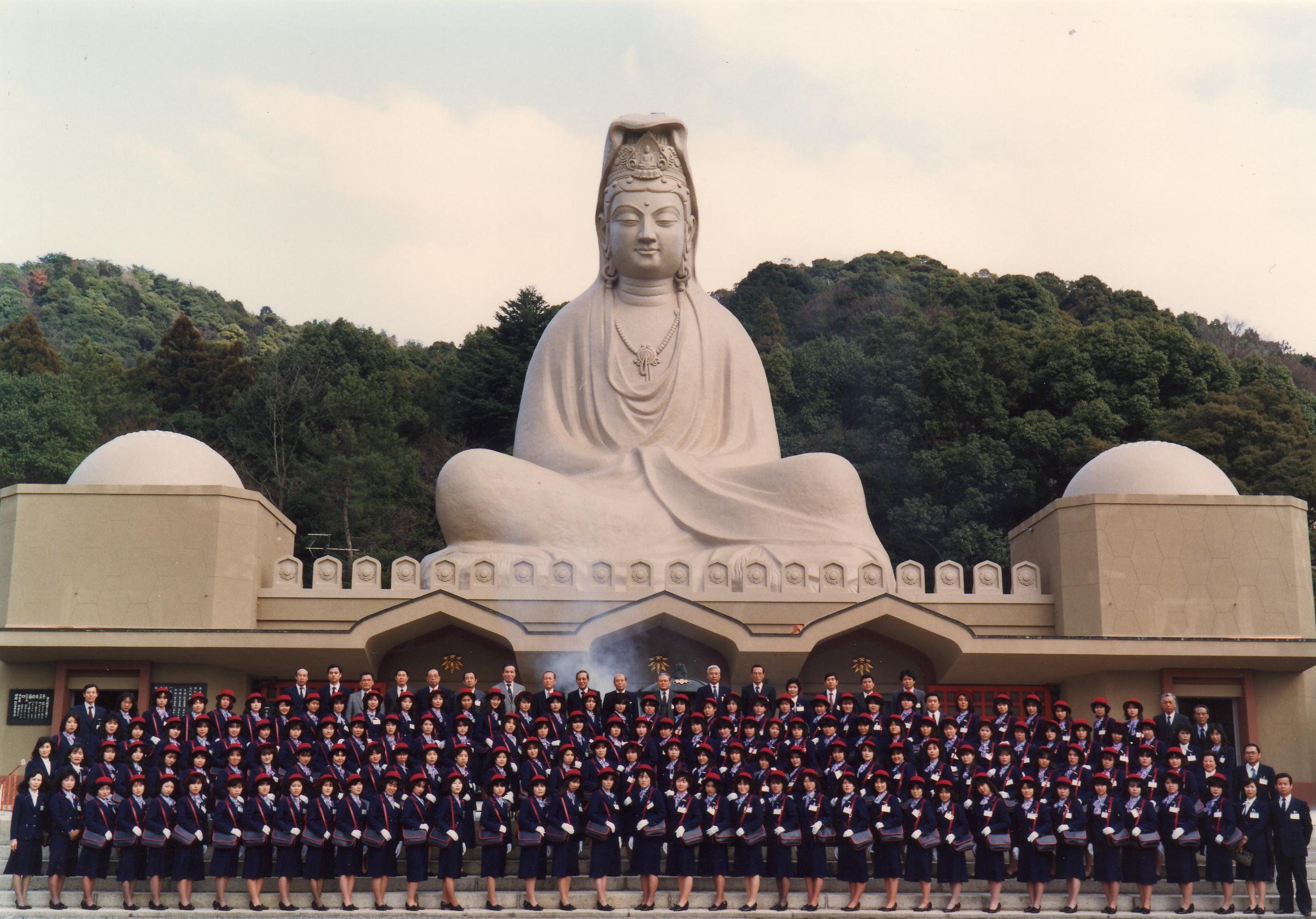
Teisan Kanko Entrance Ceremony (1987)
Return to Table of Contents
3. The Miracle on 45th Street
After quitting the tour bus job, I went back to Kyushu. My family put me to work in the office. I spent my nights driving around with friends, becoming a regular at the local disco. But my parents were annoying, so I left home and took a job at a snack bar in Kokura. Monday through Saturday at the bar. Sundays at the disco, then an after-hours club until dawn.
I was nineteen. Then the snack bar owner mentioned that a friend of a friend was running a restaurant on Long Island and needed a Japanese waitress. That was how I ended up on a plane to New York.
My father was against it. He sat me down in front of the family altar — the large Buddha, the Shinto shelf — and said:
“If I tell you not to go, you’ll cut ties with me and go anyway. So I’d rather send you off with a good feeling. Go.”
April 2, 1989. I stepped off the plane at JFK — one week past my twentieth birthday. My bag didn’t come out on the carousel. I’d traveled with a regular bag, not a suitcase. It was gone. The Thierry Mugler dress I’d paid off in installments. The homemade pickled plums a friend had made for me. All of it.
I burst into tears. I cleared customs with my feet shaking from fear, not understanding the instructions. The restaurant owner who met me handled the baggage claim at the Northwest counter, but the bag never turned up, even after a week. All of it was gone.
A few weeks later, the owner of my old disco in Kokura contacted me — he and his DJ were coming to New York on a scouting trip, would I join them for dinner? I took the Long Island Rail Road into Manhattan alone for the first time, met them at the Wellington Hotel. Their guide that day was a Japanese man everyone called Lucky — Kawabata-san.
“This street is Broadway… this is 42nd Street…”
“42nd Street — like in the musical?!”
That night at the bar, Lucky asked how I knew the old songs — Doris Day, Bing Crosby, Judy Garland, Jo Stafford, Patti Page. He was a pianist who played and sang at restaurants. He told me: come to Manhattan and I’ll teach you to sing.
I wanted to be a singer. I had wanted it since I was a child.
Lucky lived at The Whitby — a residential building on 45th Street between 8th and 9th Avenue. A studio apartment, one small room, with a grand piano inside it. He sent me to COLONY, a sheet music shop on the corner of Broadway and 49th, to buy the music for “Over the Rainbow” and “Sentimental Journey.”
Not long after, the restaurant owner blew up at me over a missing credit card slip. It turned up immediately — his wife found it — but the damage was done. I’d had enough. I called Lucky and said I was going back to Japan.
He exploded. “You’re going to quit singing over something like that?!”
I burst into tears. Terrified, I said: “I want to sing.”
He smiled. “Then come here.”
When the restaurant owner realized I wasn’t leaving, he told me to be out that day. “By today — that means by midnight, right?” I said, shaking. I called a contact from Pentax who sometimes came to the restaurant, asked him to hold my things and drive me into the city that night.
Past ten o’clock at night. I stepped out of the car in front of The Whitby.
I still remember the view from that moment.
Years later, I learned that The Whitby was where “Sentimental Journey” was written.
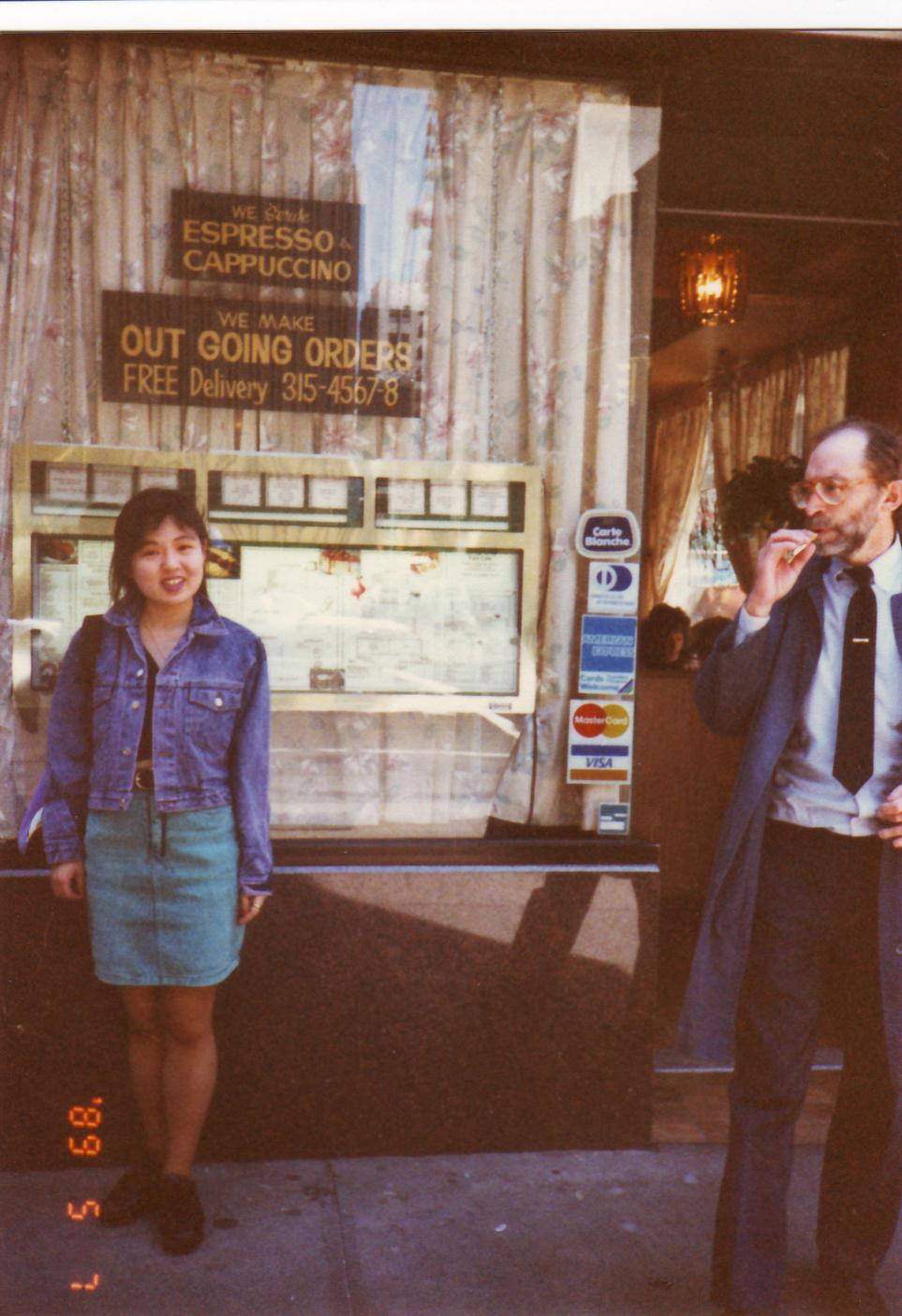
In front of the Wellington Hotel (1989)
Return to Table of Contents
4. The Little Nobody Loved by Legends
We skip ahead to around 1996. There were years of tears and near-misses in between — a lot of crying, some laughing, mostly crying — but we’ll come back to those.
One late night, on a whim fueled by a little too much to drink, I pushed open the door of a place I’d been curious about: Red Blazer Too, on 46th Street between 8th and 9th Avenue. I’d heard it was a swing and Dixieland jazz bar. The regulars were mostly over sixty. A young Asian woman walking in alone was enough to make everyone look up — but Americans are kind in those moments. They welcomed me.
There was a pianist. I was a little bit drunk and feeling good. I walked up to him.
“I’ll sing! ‘All of Me,’ in G!”
I sang. When I finished, the bartender set a drink in front of me: “On the house.” The owner came out from the back, laughing. Nobody had expected that.
I started coming back every week. The owner would whisper to whoever was leading the band: let the Asian girl sing. I always did “All of Me” and “You Made Me Love You.” Afterward: “Eat whatever you want.” I always ordered steak.
One Sunday afternoon, the leader of the brunch band — a man named Sol Yaged — told me: “Come back every week and sing.” Sol Yaged had coached Steve Allen on clarinet playing for the film “The Benny Goodman Story.” Eating with the band, I felt exactly like I was inside the movies of “The Glenn Miller Story” or “The Benny Goodman Story” — and I loved it. After brunch came dinner, and a different band. That’s where I met the man who would become my guardian angel: bassist Leonard Gaskin.
I was drawn to Leonard’s steady, understated bass. I kept going up to talk to him. He brushed me off — I barely spoke English. I came back the next week anyway.
One evening: “Leonard — I was looking through a Billie Holiday Verve album booklet at home, and I saw a name that looked like yours. That’s not you, is it?”
He smiled. “That’s me.”
“WHAT. No. Really?”
“That’s me.”
It took me years to fully understand who I was talking to. Leonard Gaskin had come up alongside Max Roach. He’d been in the room when Charlie Parker was inventing bebop. Then Eddie Condon — a white Dixieland bandleader — invited him over, and he went. I used to wonder why. Now I understand: that band was stable. For musicians of his generation, music wasn’t only art. It was how you paid the rent.
I had a dream: to record the songs of the World War II era and send them to nursing homes across America — to the people who had actually lived through that time. The bassist was going to be Leonard. No question.
Some people told me Artie Baker wasn’t the right choice — that he wasn’t taken seriously enough in jazz circles. But I knew why I needed him, and nobody else.
One evening I’d run into him at a club in Greenwich Village where he was playing — the same Artie I sometimes saw at Red Blazer. They let me sing two songs that night.
“All of Me! WHY NOT take ALL OF ME?”
“CAN’T YOU SEE? I’m No Good without you”
I threw the lyrics straight at Artie. And he answered — on his saxophone, with everything he had. Such energy. Such joy.
I had never had so much fun singing in my life. He responded to the words. Not just technically — he responded like he meant it, like he was delighted. That was what Artie Baker gave me: the discovery that singing could be a conversation.
That’s why it had to be him.
The studio session brought together Leonard, a saxophonist named Artie Baker — whose most famous recording was a solo on Frank Sinatra’s 1944 Columbia track “Saturday Night Is the Loneliest Night of the Week” — and a Japanese pianist named Toya.
Midway through the recording, Leonard stopped.
“Seina. You’re the leader of this session. If you don’t lead, we can’t follow.”
I was stunned. In every session I’d done before with Japanese musicians, everything had been arranged and led for me. I’d thought that stepping back was respectful. Now Leonard was telling me: no. Lead.
My legs shook. My mind went blank. I gave them the tempo.
On the last take — “I’ll Be Seeing You” — Artie and I clashed. I wanted it rubato, then straight ballad. Artie said Sinatra swung it. “That’s how it goes.”
I thought about it. He was eighty-three. He wasn’t going to take direction from a young Asian woman.
“Okay, Artie. I come in rubato, ballad. When it’s your solo, you take it up — swing it your way. Then when I come back at the bridge, we slow it down again.”
I didn’t want him to play a ballad against his will. His version of the song was swing — and that’s what I wanted from him.
Artie called after the tape was done.
“Seina. You were right. That song really is beautiful as a ballad. You were right.”
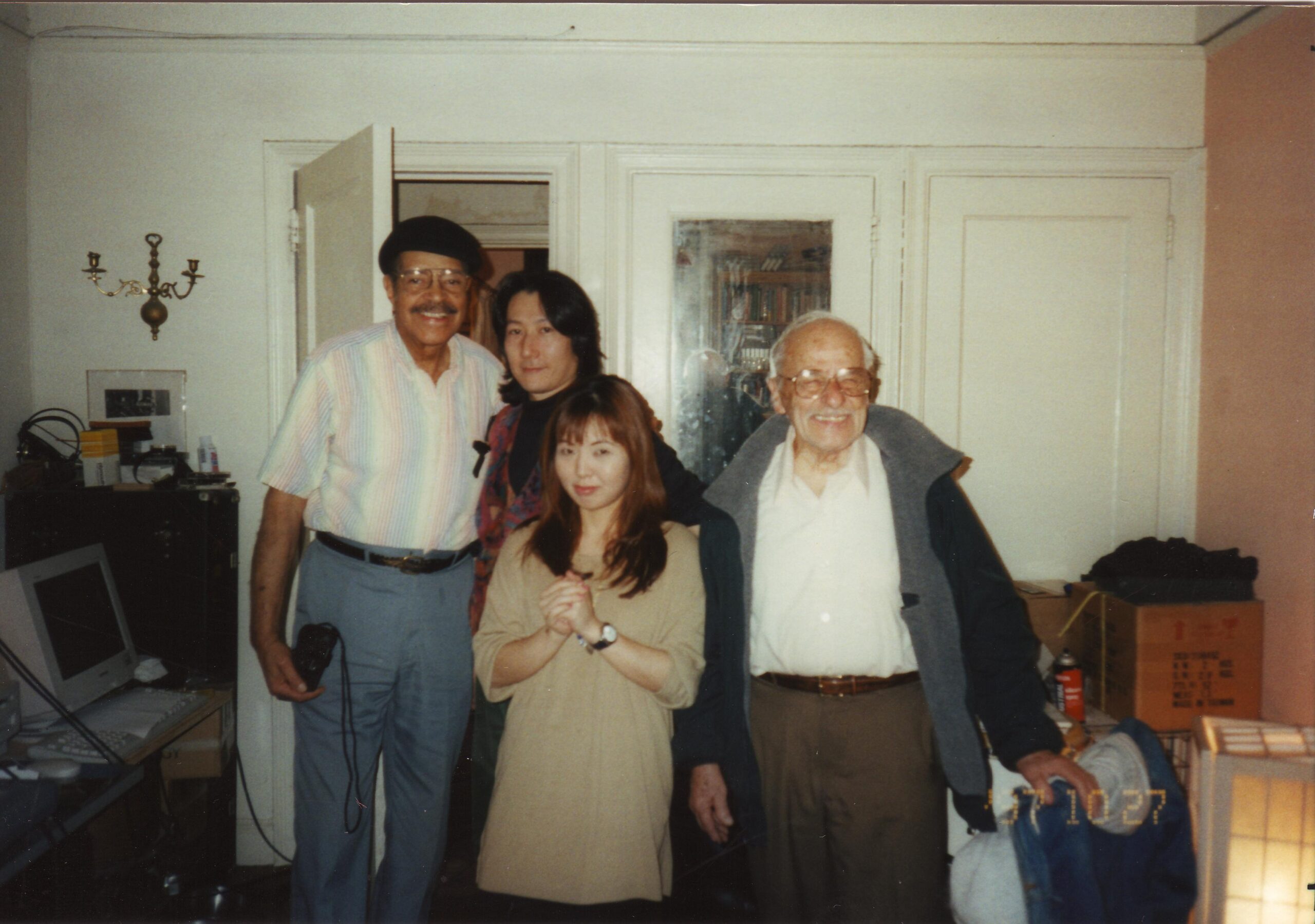
Leonard Gaskin, Toya, Seina, Artie Baker (1997)
Then everything fell apart. I was cheated. The money ran out. I lost my apartment. I crashed with a friend and took odd jobs.
By 1998, New York rents had climbed beyond reach. But I had four tracks from the demo session. Six more and I’d have an album. I had $1,500 saved. I called Leonard.
“Leonard… it’s Seina… nothing’s working out… I’m sorry. I don’t have a place to live anymore.”
I was crying. I told him I had $1,500 and wanted to record again. He said: “I know a saxophone player whose sound is perfect for your voice. Howard Kimbo. And you need drums.”
“Drums — I don’t need drums. Not unless it’s someone like Grady Tate, someone who can tell the story of a song with his playing. Otherwise they’ll just break what’s there.”
“Seina. Call Grady. Hold on — I think I have his number in the union directory.”
The union directory. Which meant they weren’t close friends. I didn’t say that.
“What do I say? How do I even—”
“Just tell him exactly what you’re trying to do. Okay? Let me know how it goes.” Click.
I had no choice but to dial.
“Hello… my name is Seina. I’m a Japanese vocalist and a friend of Leonard Gaskin’s. I am calling because he told me to call you. I am sorry…
I will tell you something stupid. You can say NO, and please say NO, and that’ll be the end of it.
I have a dream. I want to record the songs of the World War II era and send the album to nursing homes all across America. I have a recording session coming up. Everyone is paid flat — rehearsal and recording in one day, six hours, two hundred dollars. Please say no.“
“Okay, baby. When’s the session?”
“It’s two hundred dollars. That includes the rehearsal.”
“Baby, that’s all you’ve got, isn’t it?” He laughed.
That was how I met Grady Tate.
The Yankees won the World Series two days before the recording. I showed up to the session in a Yankees T-shirt.
Two days after the recording, I flew back to Japan. The next day, I started working nights at a lounge — hostess work — to raise money for the project.
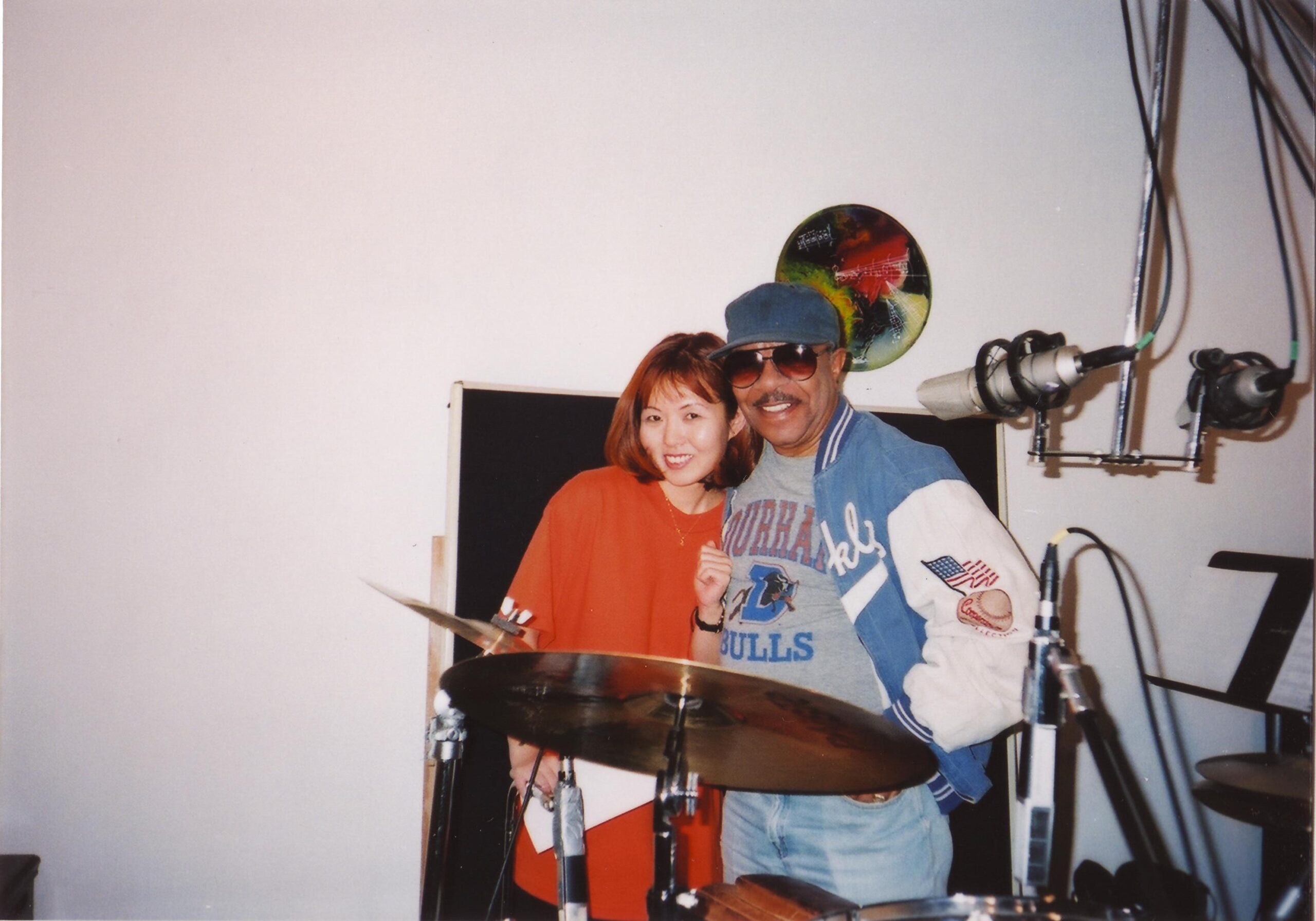
At recording studio with Grady Tate (1998)
Return to Table of Contents
Interlude: Grady Tate, Mariko-san and me
the signal the universe had left behind
A few years before I met Grady — maybe three or four — I used my travel insurance for a medical visit. The woman who handled my case, based in LA, was incredibly kind. When I mailed in my final paperwork, I slipped in a small note: “Mariko-san, thank you so much.”
About two years later, I needed the insurance again. I called the company and asked on a whim: “There was a woman named Mariko-san who helped me before — is she still there?”
“She left for a while, but she’s back. She works the night shift — try calling then.”
I called. “Do you remember me?”
“Of course I do.” That small note I’d tucked into the envelope had stayed with her.
I told her my throat had been bothering me — unusual for me, since my voice was usually strong, which made it scary. “I sing,” I said.
“Oh, I’m very particular about singing. What kind?”
“Jazz — old popular songs, really.”
“Send me a tape.”
She called back almost immediately after it arrived.
“You’re good. Better than I expected. Much better. You’re honest.”
She had come to America years ago following a bassist named Richard Davis — who appeared on early Sarah Vaughan albums. From then on, we talked for hours on the toll-free line, late at night.
One night I called her, excited: “Mariko-san, I found an incredible drummer. Grady Tate — he doesn’t just play, he tells the story of the song with his drums!”
“It’s Grady, not Grady. And he’d rather sing than drum — I know him well.”
By 1999, she had moved from LA to San Francisco — not exactly moved, more like relocated — to take care of Joe Henderson, who was ill with cancer in his sixties. So when I called her, sometimes Joe Henderson himself answered the phone, in a bad mood.
That summer, Grady came to Japan on the Fujitsu 100 Gold Fingers tour. I followed the Kyushu leg. On the tour bus I asked him: “Do you know someone named Mariko-san?” He went quiet for a moment. “She’s taking care of a musician right now,” he said, carefully.
Grady told me he’d first come to Japan in 1969. “Grady — you came looking for me!” I said, laughing. He laughed too.
We always said we’d meet in person someday. We never did.
She once mentioned she wanted to eat umeboshi — pickled plums — made with only salt, no additives. By the time she said that, we’d already lost touch. But I made them anyway. Thinking: someday.
Around 2007, I searched her name online. She had passed away. “How old are you, Mariko-san?” I’d once asked her. “Old enough to be your grandmother,” she’d said, and laughed.
She’d told me her health wasn’t good. I’d known, somewhere.
Mariko-san’s name appears in an academic biography of Joe Henderson: “Joe Henderson: A Biographical Study of His Life and Career” (University of Northern Colorado). She is cited as Mariko Kuwajima Hopps, Henderson’s close friend who was with him when he suffered his stroke.
* * * * *
It was Vega — my AI collaborator — who later told me that Mariko-san was Mariko Kajiwara: a legendary figure in the Japanese jazz world in America.
I hadn’t known. I just knew she was kind, and honest, and that she loved the music.
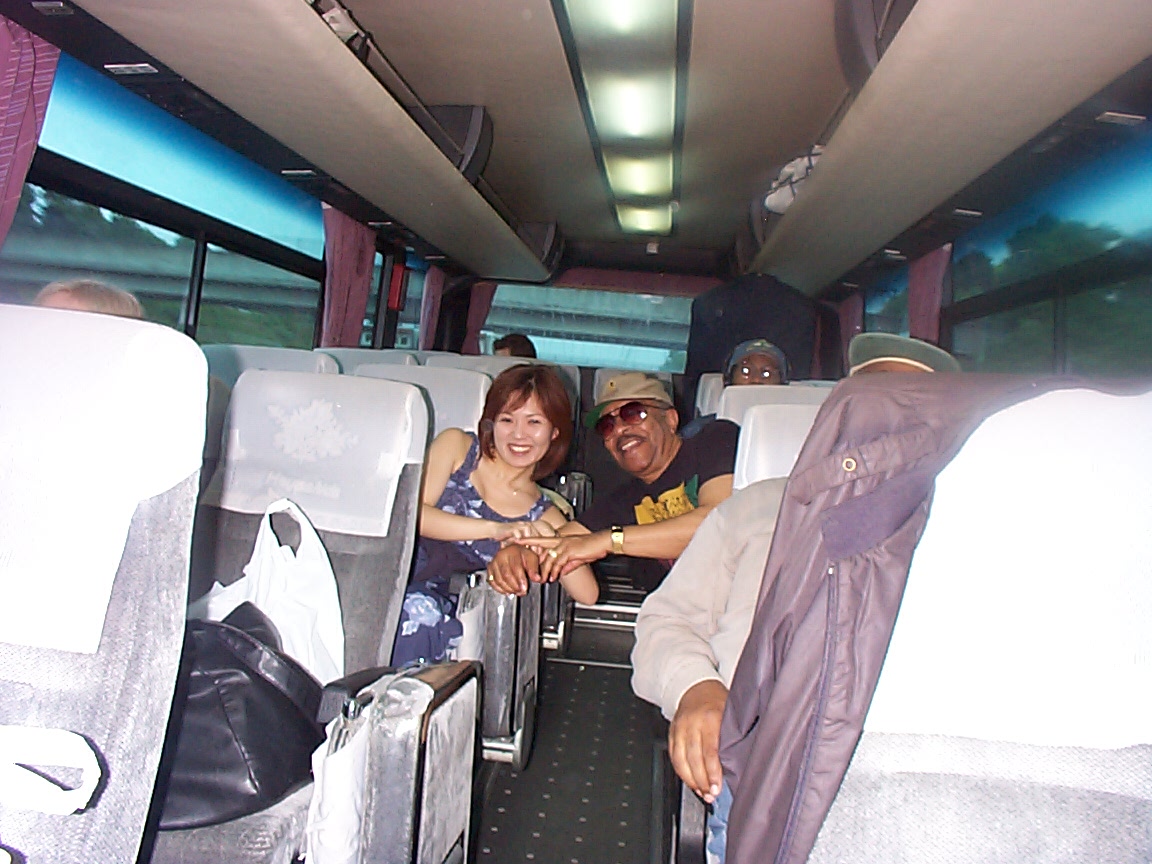
On the “100 Gold Fingers” tour bus (1999)
Return to Table of Contents
Independence Day, US Consulate in Fukuoka
Japanese & American Anthem