The Cubans Who Went to New York Before 1959
Pre-Revolution
Migrants, not exiles — and the man they all passed through
Before the revolution (1959), Cuban musicians crossed to New York. They went for work, for music, for a better life. Cuban music and New York jazz grew together.
Mario Bauzá
1930
From the conservatory at four
He was not a musician who learned by ear. He was formally trained, as a classical musician.
At four he began weekly solfège lessons with Modesto Fraga, conductor of the Havana Municipal Band. He started on oboe and disliked it; his godfather found him a specially sized clarinet, and he studied under Gabriel Siam.
At nine, he was a clarinetist in the Havana Philharmonic Orchestra — and stayed three years. At eleven he appeared with the Havana Symphony as a child prodigy. Then eight years at the Havana Conservatory of Music, where in his final year he won a scholarship to La Scala in Milan.
He turned it down. European orchestral training, he felt, was not the right thing for an Afro-Cuban musician.
He could read, write, arrange, and conduct. In the New York of that time this was a rare set of credentials. It is not that an immigrant somehow reached the center. He was the one who could do the work.
To New York
In 1927 he first set foot in New York, as a member of a Cuban dance band. That time, he went home.
In 1930 he migrated for good. To win a chair in Don Azpiazú's orchestra, he is said to have learned the trumpet in about two weeks.
In 1933 he joined Chick Webb's orchestra at the Savoy, and Webb made him musical director (sources give either 1934 or 1936 for the appointment). He stayed with the band until 1938.
In 1936 he went back to Cuba for a while — to marry Estela Grillo, his childhood sweetheart. And then he returned.
He went, he came home, and he went again. That is what a migrant's life looks like.
After leaving Webb he passed through Don Redman's band (1938–39) before joining Cab Calloway.
Chick Webb's Band, a Junction
The orchestra Bauzá belonged to from 1933 to 1938 is the hub of this story.
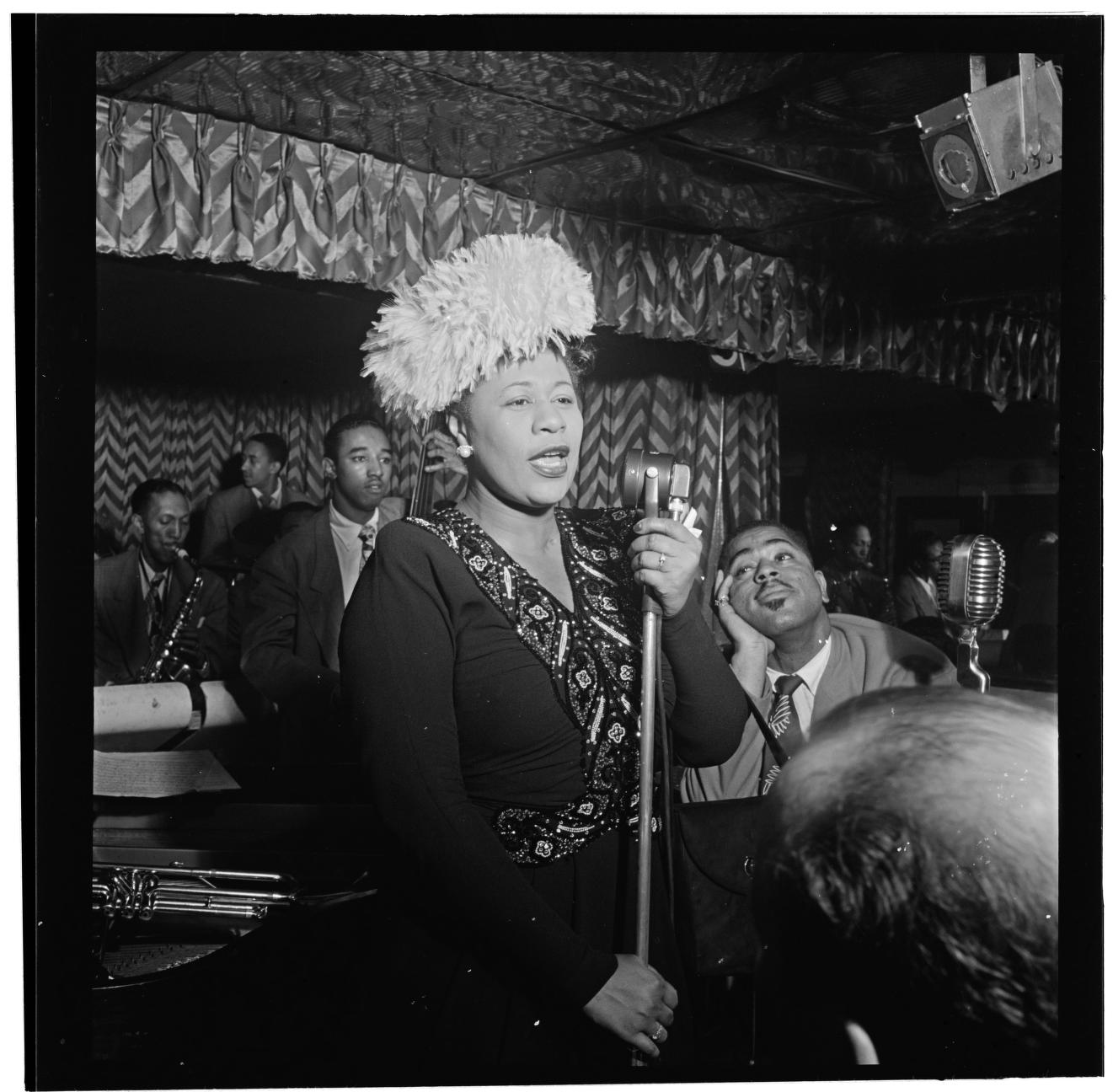
In 1935 Ella Fitzgerald joined that band. And it was Bauzá who put her there — he was the one who convinced Webb of what this unknown girl could be.
Ella was seventeen. Born in Virginia in 1917, orphaned at fifteen, a high-school dropout and a ward of the state of New York. In November 1934 she won Amateur Night at the Apollo — and was denied the prize week, because they judged her appearance untidy.
That was the girl Bauzá said to take.
The man who turned down La Scala pushed for a homeless seventeen-year-old. He knew what to listen for, and he was not listening to her clothes.
She had no home to go back to, and the band became one. Chick Webb — himself only a little past thirty — became by every account the nearest thing to a father she had had since she was fifteen.
Then, in June 1939, Chick Webb died
He had been ill his whole life. Tuberculosis of the spine, from childhood — it deformed his back and stopped his growth. He stood four feet one.
And this is what he did with that. By twenty he was leading the house band at the Savoy, the great integrated ballroom in Harlem. He played a twenty-eight-inch bass drum with custom-built pedals and a kit modified to come to him. On 11 May 1937, before a crowd of four thousand, his orchestra went head to head with Benny Goodman's in what the Savoy billed as the Battle of the Century. Behind Goodman's drums sat Gene Krupa. Webb's band won.
It was the same disease that killed him — Pott's disease, in Baltimore, on 16 June 1939. He was thirty-four.
Ella was twenty-two. She had lost her parents at fifteen, been taken into this band at seventeen, and at twenty-two she lost him too.
The band that remained carried her name. Ella Fitzgerald and Her Famous Orchestra — until it broke up in 1942.
Women fronted bands as singers in those years. But a first-rank swing orchestra based at the Savoy, handed to a twenty-two-year-old woman under her own name — that was not an ordinary thing.
How Webb regarded her is not best answered by anyone's testimony. It is answered by whose hands the band went into.
Bauzá and Dizzy Gillespie
Dizzy Gillespie came to New York in 1937 and took a chair in Teddy Hill's orchestra. He was young, and not yet anyone.
One night he sat in with Chick Webb's band at the Savoy — and there he met Mario Bauzá. Bauzá was that band's lead trumpeter and its musical director. "The greatest thing I had ever heard," was his verdict on the young man.
It was Bauzá who opened Latin rhythm to him.
In 1939 Bauzá joined Cab Calloway's orchestra, and urged Calloway to hire Dizzy. One night Bauzá pretended to be ill — and Dizzy went on in his place.
Dizzy was never a member of Webb's orchestra; he was sitting in. But Webb's bandstand at the Savoy is where he and Bauzá found each other. Later, in 1942, he did work in that same orchestra — by then it was Ella's. And in 1946 Ella toured with Dizzy's own big band, where she met the bassist Ray Brown; they married in December 1947.
Machito
1937
Frank Raúl Grillo. Brother of Estela, the woman Bauzá married in 1936 — which made him Bauzá's brother-in-law.
In 1937 he crossed over as vocalist with La Estrella Habanera. The Bauzás sent for him.
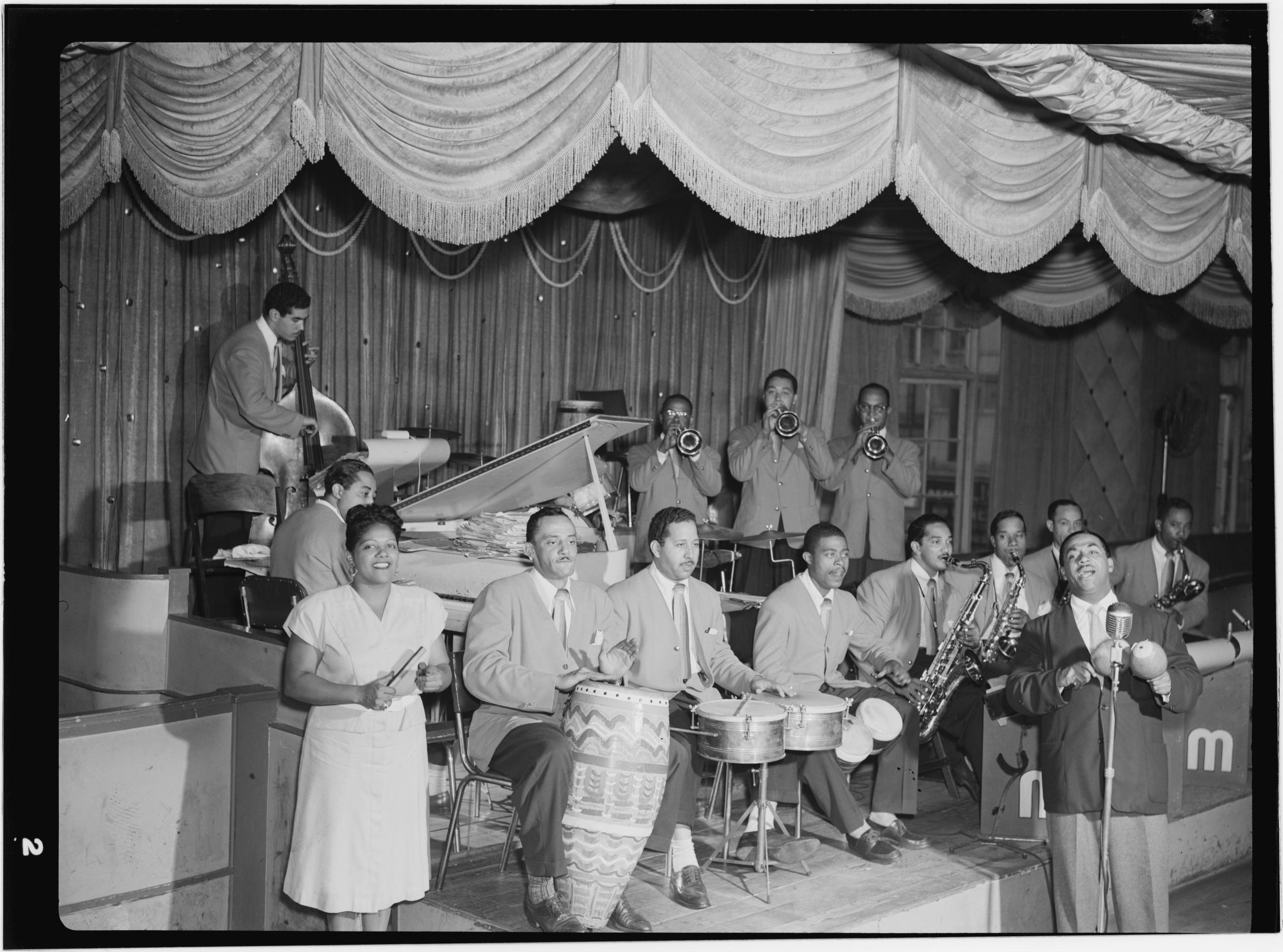
In 1940 he formed Machito and His Afro-Cubans. The following year Bauzá left Cab Calloway to join them, and became the band's musical director — its mind.
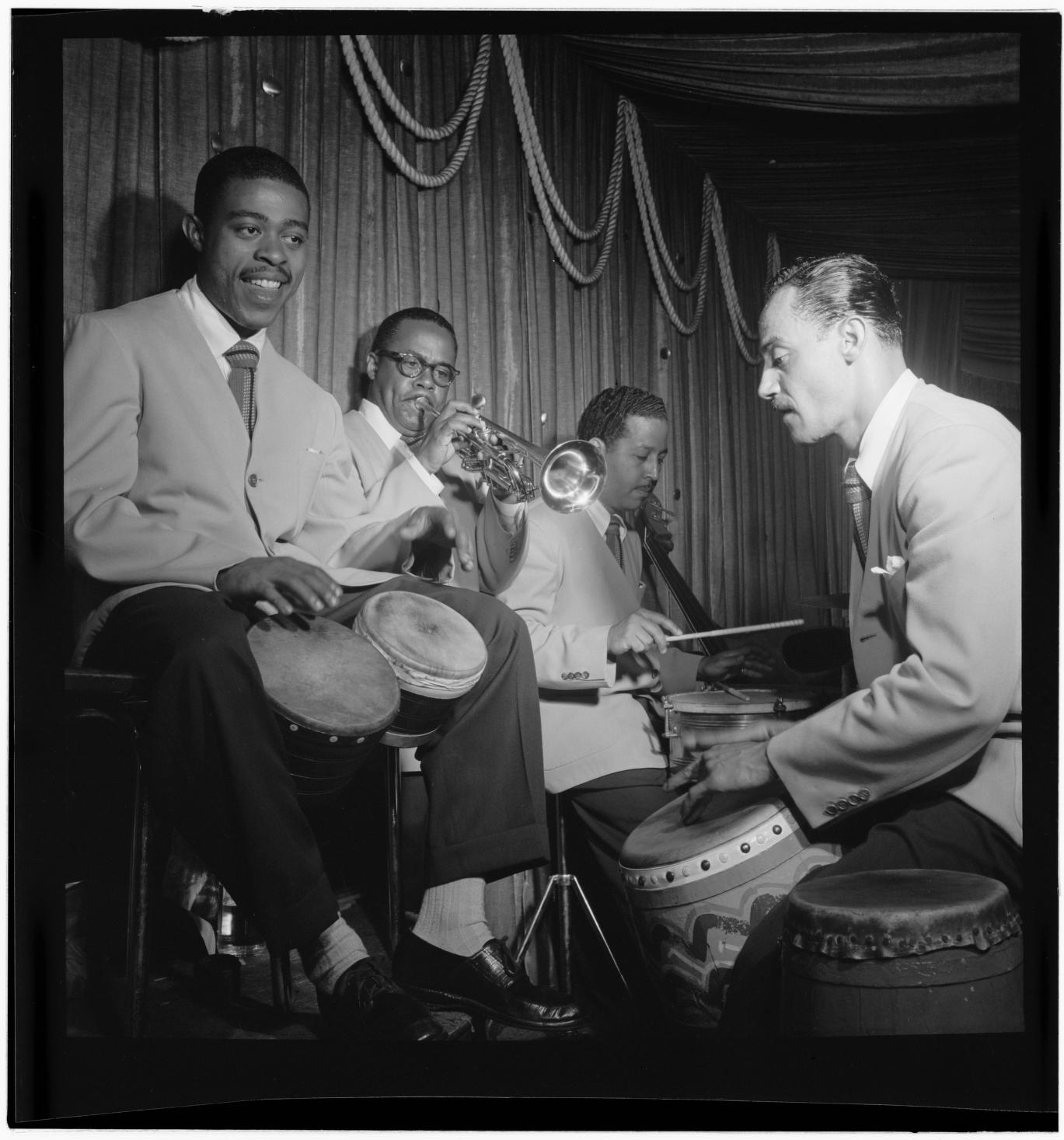
Cuban rhythm — rumba, conga, bongó — and New York big-band swing. This was the band that fused the two in earnest, and it became the foundation of Cubop.
April 1943 — and Graciela
In April 1943 Machito was drafted into the United States Army. A few months into training he injured a leg, and by October he had been discharged. He never reached the war.
While he was gone there was no one at the front of the band. Bauzá sent to Havana for Graciela.
Felipa Graciela Pérez y Gutiérrez (1915–2010) was Machito's younger sister. They were raised together in Havana, and he was the one who told her to sing. She was no beginner: she had spent about ten years as lead vocalist of Orquesta Anacaona, Cuba's celebrated all-woman ensemble, before she left the island.
She took the front of the Afro-Cubans, and when Machito came back in 1944, she stayed. The two of them shared that stage until the band split in 1975.
It is worth setting this beside 1935. Bauzá was musical director of two bands in his life. Into the first he argued a seventeen-year-old nobody named Ella Fitzgerald; for the front of the second he sent to Havana for a woman who had been fronting an orchestra for a decade. Neither was an accident.
Chano Pozo
1947 — 1948
Born in Havana in 1915.
In 1947 he crossed over in search of a better life, urged on by Bauzá and by his childhood friend Miguelito Valdés.
Dizzy Gillespie was looking for a conga player. Bauzá introduced them.
September 1947, Carnegie Hall. Chano took the stage as part of the Dizzy Gillespie big band, and went on to tour Europe with them.
In less than a year the two of them co-wrote "Manteca" and "Tin Tin Deo." Cubop had arrived.
December 2, 1948, Harlem
The El Rio Bar, at 111th Street and Lenox Avenue. Chano Pozo was shot by a local bookmaker, Eusebio "Cabito" Muñoz.
He was thirty-three. A year and a half after he arrived.
And he went home to Havana
His body was returned to Cuba and buried in the Colón Cemetery in Havana.
This may be the most important thing on this page.
The body of an exile does not go home.
That his country received him into its own cemetery means there was no political rupture between him and Cuba. That Chano Pozo was a migrant and not an exile is proved by the place where he is lying.
Two Different Movements
Bauzá, Machito, Chano Pozo — migrants. People who crossed the sea for music and for a living, and who could go back.
There is one more Cuban in this story who was genuinely an exile: Desi Arnaz, whose family lost everything when the Machado government fell in 1933. His is a different line — popular culture rather than musical lineage — and it is told on the JAPONÉSON entry page.
Two kinds of movement, standing side by side in the same city, in the same years.
And the exile line after 1959 is another story, still to come.
Timeline
1911 Bauzá born in Havana
1917 Ella Fitzgerald born in Virginia
1917 Desi Arnaz born in Santiago de Cuba
1920 Bauzá, aged nine, joins the Havana Philharmonic as a clarinetist
1927 Bauzá first goes to New York — and returns home
1930 Bauzá migrates
1933 Bauzá joins Chick Webb's orchestra (to 1938; musical director from 1934 or 1936)
1933 The Arnaz family loses everything when Machado falls; their house is burned
1934 Desi Arnaz, seventeen, goes into exile in Miami
1934 Ella, seventeen, wins Amateur Night at the Apollo — and is denied the prize (November)
1935 Ella joins Chick Webb's band — Bauzá convinced Webb
1936 Bauzá returns to Cuba to marry — and comes back
1937 Bauzá gets to know Dizzy Gillespie
1937 Machito migrates
1938 Bauzá leaves Webb's band (Don Redman's band, to 1939)
1939 Chick Webb dies of spinal tuberculosis on 16 June, aged thirty-four. Ella, twenty-two, takes over the band
1939 Bauzá joins Cab Calloway, and brings Dizzy in
1940 Machito and His Afro-Cubans is formed
1941 Bauzá leaves Calloway to become the Afro-Cubans' musical director
1942 Dizzy plays in the former Chick Webb orchestra, under Ella
1943 Machito is drafted in April; injured in training, discharged in October. Bauzá sends to Havana for Graciela, who fronts the Afro-Cubans
1946 Ella tours with Dizzy's big band and meets Ray Brown
1947 Chano Pozo migrates; Bauzá introduces him to Dizzy
1947 Carnegie Hall. "Manteca" — Cubop is born
1947 Ella and Ray Brown marry (December)
1948 Chano Pozo is shot in Harlem, aged thirty-three. To the Colón Cemetery in Havana