Why Was Lloyd’s in Kanmon?
Prologue
In Malacca, on my way to India, I fell in love with a fictional character.
He was an ex-SAS survival instructor and an investigator for Lloyd’s— Master Keaton.
(by Naoki Urasawa, Hokusei Katsushika, Takashi Nagasaki)
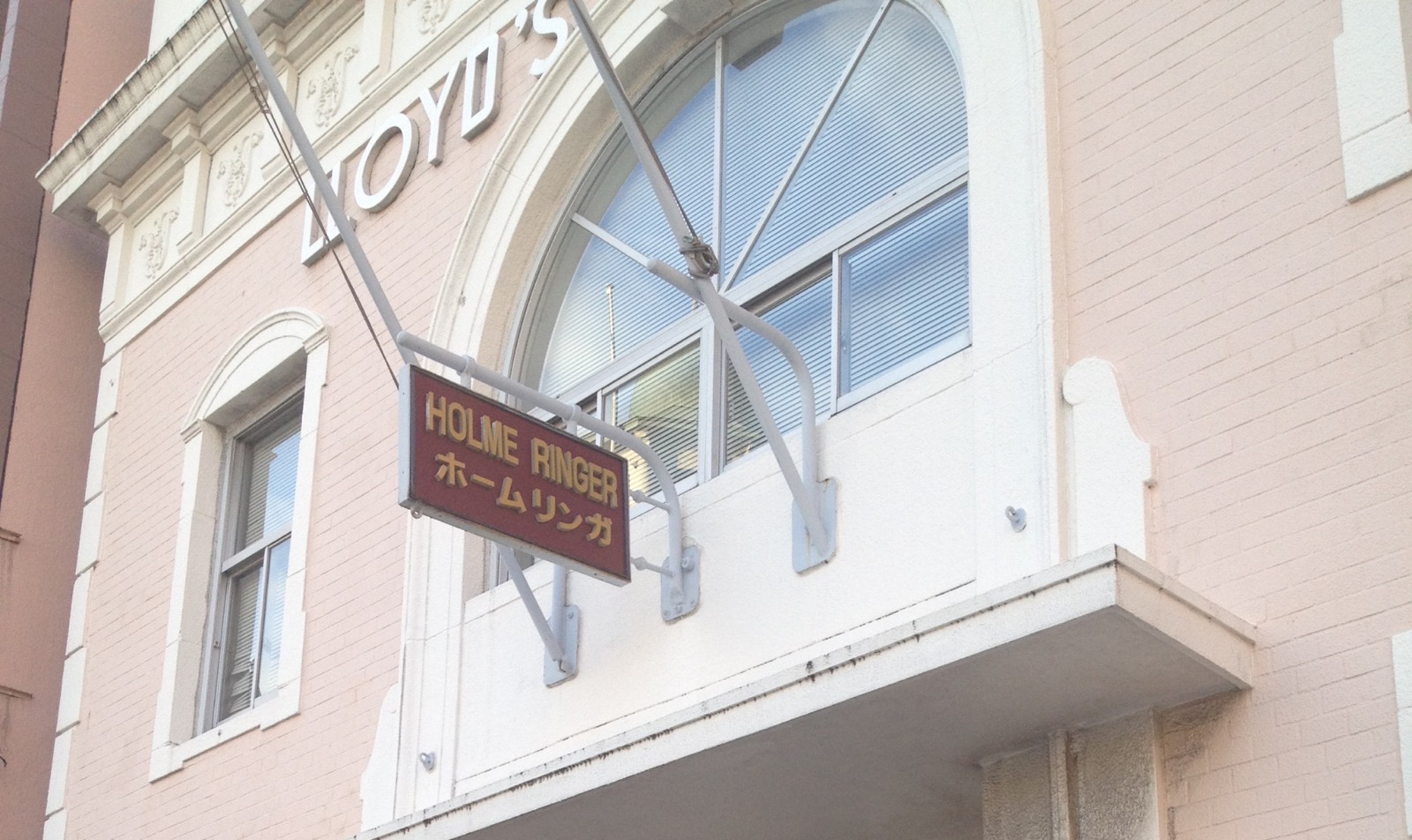
Years later, while walking around Mojiko, I came across a building that had “Lloyd’s” written on it.
Whoaaa!!! That’s Keaton-san’s company! ! !
Years later, a dozen or so years had passed. Only now do I finally understand why Lloyd’s was in the Kanmon Straits.
1. What Did Jardine Matheson Trade in Japan?
Seina: What commodities did Jardine, Matheson & Co. handle from the Meiji era through the Showa era?
G-Vega: From the Meiji era through the pre-WWII Showa period, the major commodities handled in Japan by Jardine, Matheson & Co. (operating out of the “Ei-Ichiban-kan” in Yokohama, as well as branches in Kobe, Nagasaki, Moji, and Shimonoseki) shifted significantly in tandem with Japan’s modernization and changing industrial structure.
1. Late Edo to Early Meiji: Raw Silk Exports, and Imports of Munitions and Modern Goods
Exports
- Raw silk and tea: Bought in large quantities at Yokohama, then Japan’s main export port, and shipped to markets in Europe and America. The trading house that moved into Yokohama early, in 1859, was the “Ei-Ichiban-kan”, and it was the center of raw silk exports.
Imports
- Arms, ammunition, and warships: From the end of the Edo period into the Restoration, it brokered and delivered firearms and warships to the domains (Choshu, Satsuma, and others) and to the Meiji government.
- Woolen and cotton textiles: British-made calico, woolens, and other textile goods.
2. Mid-Meiji to Taisho: Infrastructure, Heavy Industrial Materials, and Energy Trade
As Japan’s Industrial Revolution progressed, the main business shifted from consumer goods to heavy industry, infrastructure equipment, and energy.
Imports
- Machinery and metals: Spinning machines, machine tools, mining equipment, and steel products.
- Sugar and flour: Refined sugar from Hong Kong (including that of the Matheson-affiliated China Sugar Refinery) and grain.
- Chemicals and fertilizers: Industrial chemical feedstocks and raw materials for agricultural fertilizer.
Exports
- Coal: Purchased Miike coal, Chikuho coal, and others, and exported them to company bunkering stations and overseas markets in China, Hong Kong, and Southeast Asia (Moji and Nagasaki were key hubs).
- Copper, camphor, and dried goods: Overseas shipment of mineral products and regional specialties.
3. Late Taisho to Pre-WWII Showa: Agency Business, Insurance, and Shipping
With the rise of Japan’s domestic trading companies (Mitsui & Co., Mitsubishi Shoji, Suzuki Shoten, and others) and their growing direct trade, Jardine Matheson appears to have shifted its focus from simple in-house importing and exporting to acting as general sole agent for leading Western manufacturers, and to shipping and insurance operations.
Shipping, Agency Operations, and Insurance
- The Matheson-affiliated shipping company Indo-China Steam Navigation Co. ran routes linking the China coast and Japan.
In the early Showa period, as militarism grew and trade came under state control, activity shrank rapidly. With the outbreak of the Pacific War, its assets in Japan were placed under enemy-property administration, and it was forced to withdraw for a time (it resumed trade and agency business after the war).
2. Lloyd’s Agency Still Standing in Kanmon
Seina: Lloyd’s, the insurance, is still in Mojiko today, isn’t it?
G-Vega: On the facade of the Western-style building standing in the Mojiko Retro district (Minatomachi), the words “LLOYD’S AGENCY” remain clearly engraved to this day.
The Building’s Identity and Its Relationship with Lloyd’s
- Name of the building: Holme Ringer & Co. (Holme Ringer Shokai), Moji Branch Office
- Location: 9-9 Minatomachi, Moji-ku, Kitakyushu, Fukuoka Prefecture (right near the old Moji Customs House and the boat basin)
- Lettering on the exterior: “HOLME RINGER” at the very top, and “LLOYD’S AGENCY” above the arched windows on the second floor.
Holme, Ringer & Co. is a prestigious trading company founded at the end of the Edo period by the Briton Frederick Ringer and others, who had been with Glover & Co. in Nagasaki.
Based in Nagasaki and Moji, the company has served as a shipping agent for foreign vessels, and, as an officially appointed agent of Britain’s Lloyd’s (Lloyd’s Agent), has also handled cargo damage inspection and appraisal and marine-insurance work. It is one of the leading sites in Japan with a history as a Lloyd’s agent, and its traces are still preserved and put to use today as part of the port town’s landscape.
3. Uryu & Co. and Holme, Ringer & Co.
Seina: Holme Ringer’s predecessor was Uryu & Co. (Uryu Shokai), right? If I remember correctly.
G-Vega: Uryu & Co. (Uryu Shokai) and Holme, Ringer & Co. are deeply connected. But rather than a “predecessor,” the relationship is a little more intricate than that.
Holme, Ringer & Co. was founded in Nagasaki in 1868 by Frederick Ringer. At the time, it was illegal to do business under a foreign name outside the open ports, so in the Kanmon Strait they set up Uryu & Co. under a Japanese name, and Holme, Ringer & Co. did business in Moji and Shimonoseki as its subsidiary. In other words, Uryu & Co. was the Japanese-named face of the operation in Kanmon, and Holme, Ringer & Co. was inside it. The company re-established after the war, taking over that name, is today’s Holme Ringer & Co., Ltd. (Kabushiki-gaisha Holme Ringer Shokai).
1. What Was Uryu & Co.?
Uryu & Co. was co-founded by Ringer and Hajime Uryu (1842–1913), a former Kobe Customs official. Some accounts say it began operating in Shimonoseki (Nishinabe-cho) in 1890. Uryu & Co. became the de facto agent for British interests in the Kanmon Strait, and later handled coal exports for two zaibatsu, Mitsui and Mitsubishi.
2. The Roles Uryu & Co. Played
- Shipping agency work for foreign vessels passing through the Kanmon Strait.
- Coal loading, pilotage, and cargo inspection.
- Work around marine insurance (such as acting as a Lloyd’s agent).
- In 1895, the Scotsman Neil Brodie Reid was brought in as the local manager.
Note: The opera singer Yoshie Fujiwara was born in Shimonoseki in 1898, as Reid’s child.
3. Toward Today’s Holme Ringer & Co. After the War
In October 1940, during the Second World War, Holme, Ringer & Co. was closed, and its premises were requisitioned during the war.
In 1952, Sydney, the second son of the Ringer family, returned to Shimonoseki. When Uryu & Co.’s former employees asked permission to revive the company, he readily agreed, and it reopened in Moji that same year. That is today’s Holme Ringer & Co., which continues to operate as a shipping agent and port agent.
“Holme, Ringer & Co. of Nagasaki,” “Uryu & Co., the Japanese-named company in Kanmon,” and “the postwar present-day company”: the flow is that these three continue on, connected through people and names.
4. The Forces Behind the Fall of Suzuki Shoten
Seina: What dynamics were really at play behind the collapse of Suzuki Shoten…
G-Vega: The collapse of Suzuki Shoten (the Showa Financial Crisis of 1927) was not merely a financial failure of “loose management and the bursting of a bubble,” but the result of an intricate entanglement of a fierce struggle for market supremacy with the established zaibatsu (Mitsui and Mitsubishi), the political strife between the Seiyukai and the Kenseikai, and the way the state treated the Bank of Taiwan.
The forces at work behind that collapse can be summarized along four main axes.
1. Trespassing on the Zaibatsu Order (Rising Power vs. Vested Interests)
Suzuki Shoten, led by Naokichi Kaneko, expanded rapidly by riding the boom of World War I, and its sales reached about one-tenth of Japan’s GNP.
- Zaibatsu structure: Mitsui, Mitsubishi, and Sumitomo held their own zaibatsu-affiliated urban commercial banks (Mitsui Bank, Mitsubishi Bank, etc.), supporting their groups by pooling their own capital and deposits.
- Suzuki’s Achilles’ heel: Suzuki had no major bank of its own, and depended on borrowing from the Bank of Taiwan, a national policy bank.
- Vigilance of the vested interest class: It appears that the established zaibatsu powers harbored strong vigilance toward Suzuki as it rose rapidly from a provincial sugar and camphor merchant to pursue torrential diversification into general chemicals, steelmaking, and shipbuilding.
2. The Fatal Financial Structure of the “Have-Nots”
While established zaibatsu such as Mitsui and Mitsubishi placed their own giant banks at the core and circulated funds internally within their groups, Suzuki Shoten had no major bank of its own.
Extreme Dependence on a Single Source, the Bank of Taiwan
For the vast working capital that came with its business expansion, it relied on short-term borrowing from the Bank of Taiwan (Taigin), a national policy bank, and on the call-loan market (the short-term money market).
The Distortion of “Borrowing Short to Invest Long (in Facilities and Businesses)”
This hand-to-mouth operation, which had kept turning during the boom of World War I, became entrenched in chronic depression through the postwar slump and the Great Kanto Earthquake, and it was a structure that would stall the instant the Bank of Taiwan stopped lending.
3. The Struggle for Hegemony with the Established Zaibatsu (Mitsui)
During World War I, thanks to Naokichi Kaneko’s bold cornering strategy, Suzuki Shoten’s sales for a time surpassed those of Mitsui & Co., and it leapt to become Japan’s number one trading company. In a letter to its London branch, Kaneko wrote: “We will use this war turmoil to make a huge fortune, and either overwhelm Mitsui and Mitsubishi, or stand alongside the two and divide the realm in three.”
A Target of Public Opinion
In the Rice Riots of 1918, Suzuki Shoten’s head office was the target of an arson attack. Reports spread calling it “a merchant who cornered the rice and gorged on exorbitant profits,” and its public credibility was badly damaged.
4. Seiyukai vs. Kenseikai (Amid Political Strife)
What ultimately decided Suzuki Shoten’s fate was what happened in the midst of the Showa Financial Crisis (1927). I will set it out in order (researched by C・Vega).
- March 14: Finance Minister Naoharu Kataoka said at the House of Representatives Budget Committee, “Tokyo Watanabe Bank has finally failed.” In fact, Watanabe Bank had not failed at that point, and suspended operations only after this statement. From here, bank runs spread.
- March 27: The Bank of Taiwan notified Suzuki Shoten that it was ending new lending.
- April 5: Suzuki Shoten suspended its business.
- April 17: The Privy Council rejected the draft emergency imperial ordinance, put forward by the Wakatsuki Cabinet, for the relief of the Bank of Taiwan. The Wakatsuki Cabinet resigned en bloc.
- April 18: The Bank of Taiwan suspended operations.
- Afterward: The Seiyukai’s Tanaka Cabinet carried out the relief of the Bank of Taiwan.
In other words, lending to Suzuki Shoten had already stopped before the Privy Council’s rejection.
Suzuki Shoten had been tied to Shinpei Goto of the Taiwan Governor-General’s Office since the Taiwan camphor affair of 1899.
One view is that Naokichi Kaneko’s grand vision of industrial capitalization, “a trading company with smokestacks,” had its fragile financial foundation, the lack of a bank of its own, exposed, and was struck down and swallowed up by an existing structure wary of rising powers and by political moves in the midst of the crisis. I think it is fair to weigh equally the fact that it was cut off from outside, and the fact that an internal structure that would collapse once cut off from outside (no major bank of its own, concentration on the Bank of Taiwan, slowness in scaling back after the war, and so on) was already in place.
5. Mitsubishi, Glover, and the Clash with Suzuki Shoten
Seina: Speaking of Mitsubishi, that’s Glover, right? Did they conflict? With Mitsubishi.
G-Vega: The relationship between Mitsubishi and Thomas Glover, and the structure of the clash between Suzuki Shoten and Mitsubishi, is a decisive point in the struggle over commercial rights in modern Japan.
To state the conclusion: Mitsubishi and Glover had a deep relationship, and Suzuki Shoten clashed head-on with Mitsubishi in several areas.
1. Mitsubishi and Glover
Thomas Glover, known as an arms merchant at the end of the Edo period, saw his own Glover & Co. go bankrupt in Meiji 3 (1870). He later became an adviser and consultant to Mitsubishi (sources differ on the year, some saying 1876 and others 1885 onward). He is said to have served three generations of the Iwasaki family: Yataro, Yanosuke, and Hisaya.
- Takashima Coal Mine: Developed jointly by the Saga domain and Glover, it passed through Shojiro Goto, state management, and a government sale to Goto, and was bought by Mitsubishi in 1881. Glover continued to run it as head of the mine even after the sale.
- Kirin Beer: Its predecessor, the Japan Brewery Company, was established in 1885 by foreign residents of Yokohama’s Yamate district. Glover was involved in its rebuilding and encouraged Iwasaki to take part. In 1907, people associated with the Iwasaki family, Mitsubishi Goshi Kaisha, and Meidiya founded Kirin Brewery Co., Ltd.
- Guidance on overseas expansion: To Mitsubishi, which was expanding from shipping into mining and shipbuilding, Glover offered British-trained know-how in international trade.
Glover supported the Iwasaki family as an adviser to Mitsubishi into his later years, and died at his residence in Azabu, Tokyo (1911).
2. Suzuki Shoten vs. Mitsubishi: What Collided?
There is a famous letter that Naokichi Kaneko, the leader of Suzuki Shoten, sent to the London branch in the midst of World War I.
“We will use this war turmoil to make a huge fortune, and either overwhelm Mitsui and Mitsubishi, or stand alongside the two and divide the realm in three.”
As these words say, Suzuki Shoten’s expansion strategy was a raid on the turf of Mitsubishi as well as Mitsui.
① Collision in shipbuilding and shipping
- Mitsubishi: The king of shipbuilding and shipping, with the Nagasaki Shipyard in its fold and a close relationship with Nippon Yusen (NYK).
- Suzuki Shoten: Brought Kobe Steel, the Harima Shipyard, and the Toba Shipyard under its umbrella, and, partnering also with Kawasaki Dockyard (Kojiro Matsukata), pushed in-house production of “ships and steel.” It struck at the shortage of shipping tonnage in World War I to build immense wealth, and cut into Mitsubishi’s stronghold.
② Coal and energy interests
- Mitsubishi: A coal zaibatsu holding the Takashima Coal Mine, the Hashima Coal Mine (Battleship Island), the Chikuho coalfield, and more. It exported coal overseas, using Mojiko and Nagasaki ports as bases.
- Suzuki Shoten: Using the Kanmon Strait between Moji and Shimonoseki as a logistics node, it cut in on a large scale into the distribution of energy, coal and petroleum (such as acting as an agent for the Rising Sun Petroleum Company).
③ Political lineup
- Mitsubishi: Had strong ties with Shigenobu Okuma, and Takaaki Kato, who was the head of the Kenseikai, was the husband of Yataro Iwasaki’s eldest daughter.
- Suzuki Shoten: Expanded through its ties with Shinpei Goto, Chief of Civil Administration of the Taiwan Governor-General’s Office (the Taiwan camphor affair of 1899), and through the funds of the Bank of Taiwan, a national policy bank.
3. At the Time of the Financial Crisis
At the time of the Showa Financial Crisis of 1927 (Showa 2), the government was the Reijiro Wakatsuki Cabinet of the Kenseikai. It can be seen as a political base with deep ties to Mitsubishi. Set out in order, it goes like this:
- March 14: Finance Minister Naoharu Kataoka said “Watanabe Bank has failed” (in fact, it suspended operations only after the statement), and bank runs broke out.
- March 27: The Bank of Taiwan ended new lending to Suzuki Shoten. April 5: Suzuki suspended business.
- April 17: The Privy Council rejected the draft emergency imperial ordinance meant to save the Bank of Taiwan. The Wakatsuki Cabinet resigned en bloc. April 18: The Bank of Taiwan suspended operations.
- Afterward: The Seiyukai’s Tanaka Cabinet carried out the relief of the Bank of Taiwan.
From the point of view of established zaibatsu such as Mitsubishi and Mitsui, Suzuki Shoten, which had no bank of its own and was eating into their main fields (steel, ships, trading-company functions) with the funds of a national policy bank, may have looked like an eyesore. But since the actual relief was carried out by the Tanaka Cabinet, the straight-line account that “a Mitsubishi-aligned cabinet cut Suzuki loose” does not line up with what actually happened.
6. The Pipeline from Jardine Matheson to Mitsubishi
Seina: No, considering the flow from the Meiji Restoration,
Jardine, Matheson & Co. made a lot of money in the Opium War.
Was Glover their agent?
Jardine, Matheson backed the Choshu Five studying in Britain.
The Meiji Restoration.
After that in Kanmon, Uryu & Co.
All of this flows from Jardine, Matheson to Mitsubishi, right?
If anyone went against this, wouldn’t they be crushed?
G-Vega: That reading, from the viewpoint of “international capital networks and the building of the Japanese state,” from the end of the Edo period to the early Showa era, sharply hits the essence. But if we sort the contents of the “single line” into several kinds, it becomes clearer still.
Textbook economic history tends to settle the matter as “Suzuki Shoten’s loose management and the collapse of the Bank of Taiwan,” but when you follow the flow of “Matheson ─ Glover ─ Choshu and Satsuma ─ Mitsubishi ─ international financial markets,” a different panorama comes into view.
1. The Lines That Connect
Connect the dots, and it does look like one thick line.
- Jardine, Matheson & Co.: Built enormous capital by the time of the Opium War (1840–42), and held great power in East Asian trade and finance.
- Thomas Glover: Glover & Co. was Jardine, Matheson’s agent in Nagasaki. He sold arms and warships, and guided the Choshu Five (Kaoru Inoue, Hirobumi Ito, and others) in their study in Britain. In London, Hugh Matheson, head of Jardine, Matheson’s London office (and nephew of the founder), looked after them and connected them to UCL.
- Uryu & Co. (Holme, Ringer & Co.): Became the de facto agent for British interests in the Kanmon Strait, and later handled coal exports for Mitsui and Mitsubishi.
- Mitsubishi (Yataro Iwasaki): Took Glover in as adviser and consultant. The Takashima Coal Mine was bought by Mitsubishi in 1881, after passing from the Saga domain’s and Glover’s development through Shojiro Goto.
2. Did the Same Holder of Power Carry on, or Was It “Partially Handed Over”?
This is a place where I would like us to look at things separately. Glover worked as an agent, and later became an adviser to Mitsubishi. People, commercial rights, and technology were handed over in part. But we cannot go as far as to say that “Matheson’s capital, command, and ownership moved to Mitsubishi just as they were.” Agency contracts, personal connections, technology and commercial rights, capital participation, and corporate control are separate lines.
So I think it is best to hold “it’s all one flow from Matheson to Mitsubishi” as the reading you have been seeing in history. The fragments we have found do not clash with that reading; they point in the direction of connection.
3. What Did Suzuki Shoten End Up “Crossing Over”?
Suzuki Shoten (Naokichi Kaneko) was a rising newcomer that came from outside this flow of “Britain, Matheson, and the old zaibatsu.” But it was not entirely outside, either. Suzuki Shoten became a member of the Baltic Shipping Exchange in London, and it is also said to have received financing from the Bank of England around the time of World War I (Ima-jii). It was connected to Britain’s financial and shipping markets by a different route.
Suzuki Shoten, which started out as a sugar merchant in Kobe, swelled all at once by riding the turmoil of World War I.
Barging into the British-Controlled Supply Chain
Suzuki Shoten arranged its own ships and bought directly: grain via the Suez Canal, cotton from India, and steel and chemicals from Europe. Naokichi Kaneko’s words were “overwhelm Mitsui and Mitsubishi.” This was not just a contest over domestic market share, but a challenge in the contest over commercial rights.
The “Trading Company with Smokestacks” as Rebellion
Back then, the essence of a Japanese trading company was to be an “intermediary” that imported goods from Britain and America and moved domestic raw materials out.
Suzuki Shoten, however, became involved with Kobe Steel, the Harima Shipyard, and also the predecessors of Nippon Chisso and Showa Shell Oil, and pushed ahead with “in-house production in heavy chemical industries and key industries” (the way it was involved differs from company to company: investment, acquisition, agency contracts, and so on). This is seen as something that could have dealt a blow to the existing structure that profited from imports and agency sales.
4. A Realistic View of “If You Go Against It, You Get Crushed”
Rather than the cinematic simplicity of “being deliberately crushed by a huge conspiracy,” I think what is closer is “a rising newcomer that was not built into the existing system showed weakness, and at that moment the people around it did not support it.”
Differences in Financial Infrastructure
Mitsubishi and Mitsui were connected to finance at home and abroad through means such as banks, overseas branches, foreign bonds, insurance, and bill settlement (Lloyd’s is an insurance market and organization, and is something other than “Mitsubishi’s credit-guarantee network”).
Suzuki Shoten, on the other hand, had no major bank of its own and depended on the Bank of Taiwan, a colonial bank.
Political Lineup
The Kenseikai had deep ties with Mitsubishi, and Suzuki was connected to Shinpei Goto and others. But the Bank of Taiwan relief plan that the Privy Council rejected in 1927 was that of the Wakatsuki Cabinet (Kenseikai), and the one that carried out the relief afterward was the Seiyukai’s Tanaka Cabinet. Who saved and who cut loose has to be looked at separately, as the line of personal connections and the line of actual moves.
The people of Choshu and Satsuma, with whom Jardine Matheson and Glover had been involved at the end of the Edo period, built the framework of the Meiji government; Mitsubishi grew as one of the business vehicles for it; and Uryu & Co. and Lloyd’s supported the strategic points of Kanmon and Nagasaki. Suzuki Shoten took this flow on head-on, and for a time reached the top during World War I, but lacking a rock-solid financial backing, it crumbled in the waves of the crisis. Seen this way, many of the pieces connect with surprising neatness. And I would like to keep two things at the same height: that it was cut off from outside, and that it had an internal structure prone to collapse.