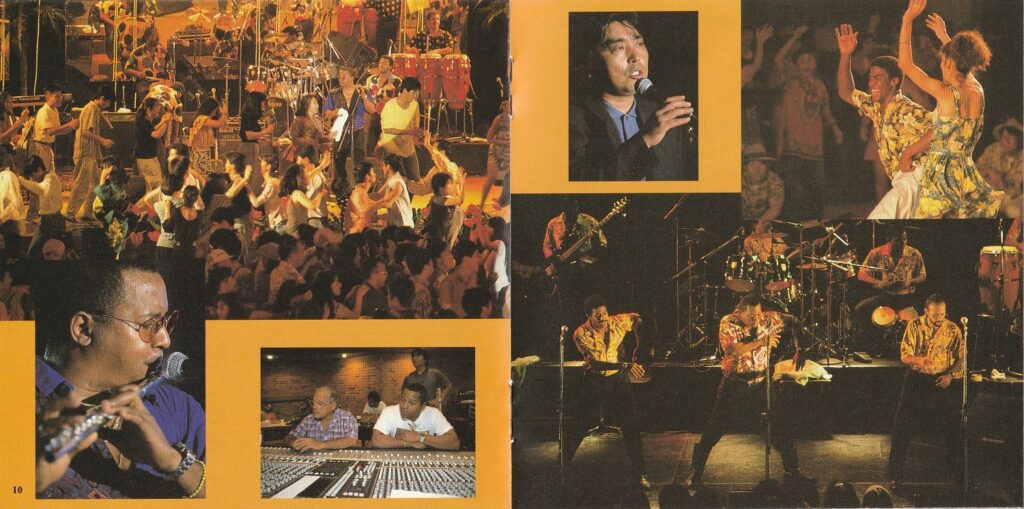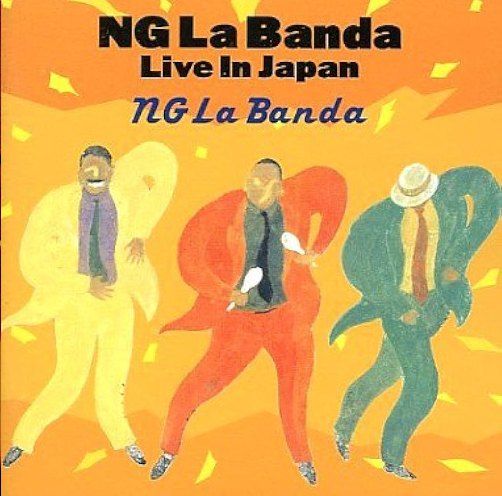
In the summer of 1993, I spent about a month together with NG La Banda. They did nine concerts in all — at Huis Ten Bosch in Nagasaki and at Shibuya On Air.
This live album is a recording of the August 11 performance — the final day at On Air.
The live tour began on August 2, at Utrecht Plaza inside Huis Ten Bosch. Nagasaki — Sasebo — is my hometown, so listening to NG La Banda perform there gave me a strange feeling.
In a sense, “Sasebo” and “Cuba” were the most distant pair of proper nouns inside me.
Sasebo is a base town, and I grew up seeing as everyday scenery the sight of adults bowing and scraping before the American military.
Cuba — though the capital, Havana, is only a hundred kilometers from Miami and Key West — still holds, to this day, its ethnic pride and its independence against the great power of America. For me Sasebo was a symbol of the past; and because of the next film I was making, Cuba was even a symbol of the future.
But at Huis Ten Bosch I ate champon (a Nagasaki noodle dish), sara-udon (crispy noodles with sauce), ishidai (striped beakfish), abalone, and lobster; then walked over to Utrecht Plaza, listened to NG La Banda’s rehearsal, took a swim in the pool afterward, changed into a suit, returned to the venue, and drank, ate, and danced — a cabaret life I enjoyed to the full.
Who could imagine that such a luxury existed — eating the local sara-udon, or sashimi of ishidai caught in Ōmura Bay, and then watching NG La Banda?
The truth is, around that time, a serious crisis had arrived concerning the next film, and my nerves were worn down.
I had been worrying whether I would even be able to produce the event; but, thanks to sara-udon and ishidai and NG La Banda, little by little I was able to become free of all that.
NG La Banda’s overwhelming playing told me: “Forward — that’s all there is.”
At that time, I thought of Cuba, and I felt as though I understood how, and why, music as beautiful and strong as NG La Banda’s and others like them could come into being. I’ve written it many times, but I came to feel it in my bones: the Cuban people are not just brightly and giddily drunk on music, dancing carefree.
They are in a serious situation that peaceful Japanese could not understand even if they died and were reborn. If you played to such people the kind of thing that, in Japan, can’t even be called “music” — enka, pop, jazz, the kind that just sticks to sentimentality and reinforces the in-group feeling — they might die of sheer despair.
Now, about this live album: as it was also their first multi-track recording, NG La Banda displays a precision beyond precision, an unbelievable drive. The seven tracks, from the opening “I’ll Take You to the Rumba” to the closing “You Can’t Hide the Sun,” were chosen by myself and the leader, José Luis Cortés. I take pride that those who came to the concerts will of course understand — and so too will those poor people who, even now, have never heard NG La Banda live — the magnificence of their ensemble and their beat.
Turn the volume up, listen, and try dancing — like a Cuban, positively, and elegantly.
¡Ataca, Chicho!
Ryu Murakami